Important note! The books, manuals, films, documentaries and docudramas listed above were chosen and recommended to our readers, among the many available on the market, solely for their clarity and the thoroughness of the topics covered. The author therefore states that he receives no compensation of any kind from the publisher, the writer or the supplier mentioned.
Anyone interested is free to buy these works wherever they see fit.
Learning more about the Apollo program
Another great classic of conspiracy rhetoric is the accusation that NASA has classified the Apollo mission data or denied the public access to it. According to this narrative, the alleged inaccessibility of the original documents (or the fact that they are reserved for "a chosen few") would be the smoking gun of the space conspiracy. Reality, however, is exactly the opposite: the Apollo program is, without a shadow of a doubt, the most rigorously documented engineering undertaking in human history. NASA's archives are overflowing with schematics, telemetry, operations manuals and public domain photographs. The real obstacle for conspiracy theorists is not a lack of material, but the inability or unwillingness to study it: the vast majority of these texts are in fact written in rigorous technical aerospace English and steeped in mathematics, which makes them hard to digest for anyone looking for easy answers or pure sensationalism ... For anyone who instead wants to raise their knowledge above prejudice, here is a selection of absolute masterpieces that no true enthusiast's bookshelf should be without:
BOOKS IN ENGLISH
"Apollo: The Definitive Sourcebook"
(by Richard W. Orloff and David M. Harland - Springer Praxis): The definitive reference. Written by a former NASA historian and a renowned space historian, it is a meticulous 635-page chronicle that examines every single mission, the pre-flight tests and even the failures, providing an absolutely unmatched wealth of statistical and operational data.
"How Apollo Flew to the Moon"
(by W. David Woods - Springer Praxis): A thrilling dive into mathematics and orbital mechanics. In its 412 pages, Woods takes the reader by the hand, explaining exactly how those machines flew and dissecting the physical principles, propulsion and trajectories that made the journey to our satellite possible.
"Virtual Apollo" and "Virtual LEM"
(by Scott P. Sullivan): The ultimate treat for lovers of visual engineering. These two volumes explore every single construction detail of the Command/Service Module and the Lunar Module through spectacular color cutaways and 3D renderings, illustrating the inner workings of every single vital subsystem.
"Digital Apollo: Human and Machine in Spaceflight"
(by David A. Mindell): A plunge into the origins of modern computing. The book tells how MIT engineers dreamed up and built from scratch the first space computer in history (the Apollo Guidance Computer - AGC), revealing the tricks behind the creation of the first integrated circuits and reproducing the listings of the primitive software that guided man through the void of space.
"Lost Moon: The Perilous Voyage of Apollo 13"
(by Jim Lovell and Jeffrey Kluger): The epic, ill-fated odyssey of Apollo 13 told in the first person by its own commander. A breathtaking account that combines the adrenaline of a space emergency with an accurate analysis of the technical causes of the oxygen tank explosion.
"Apollo - The NASA Mission Reports"
(Apogee Books): For perfectionists, a complete series with a volume devoted to each mission. These books are often enriched with CD-ROMs and DVDs containing original radio communications, flight diagrams, technical debriefings, and period photographs and video.


BOOKS ALSO AVAILABLE IN ITALIAN
"Carrying the Fire"
(by Michael Collins - CMP Apollo 11 - Italian edition: Cartabianca Editore): Unanimously considered the finest autobiography ever written by an astronaut. The Apollo 11 Command Module Pilot gives us an intimate, poetic and deeply humble account of the space mission. Far from the coldness of technical jargon, Collins describes with disarming clarity his unforgettable, solitary vigil in lunar orbit, offering the definitive psychological perspective on what it meant for a man to venture alone to the edge of the unknown.
"Forever Young"
(by John Young with James R. Hansen - Italian edition: Cartabianca Editore): The autobiography of NASA's most legendary and long-serving astronaut, the only one to have flown in the Gemini program, walked on the Moon with Apollo 16 and commanded the historic first Space Shuttle flight. With his unmistakable dry humor and a ruthless engineering mindset, Young looks back on forty years of space exploration without sparing anyone, offering a raw, technical and deeply candid account of the agency's triumphs and tragic mistakes.
"Never Panic Early"
(by Fred Haise): The title of this exceptional autobiography perfectly captures the icy composure of the Apollo 13 Lunar Module Pilot. Far from Hollywood sensationalism, Haise recounts, with a test pilot's ruthless clarity, the desperate struggle to get home after the explosion on board, showing how panic is the deadliest enemy in the void of space. The book traces a breathtaking arc spanning an entire pioneering career: from experimental flights in military fighters to the very first, extremely risky atmospheric tests aboard the Space Shuttle Enterprise. A true lesson in survival and engineering resilience.
"The Last Man on the Moon"
(by Eugene Cernan and Don Davis - Italian edition: Cartabianca Editore): The intense, visceral autobiography of the Apollo 17 commander, the man who left the last human footprints on our satellite. Far from cold engineering reports, Cernan gives us a raw and emotional testimony, telling not only of the majesty and dangers of exploration but, above all, revealing the very heavy personal and family price the astronauts paid to win the space race. It is the definitive, moving testament of an unrepeatable era.
"First Man"
(by James R. Hansen): The only official, authorized biography of Neil Armstrong. This monumental book sweeps away the romanticized aura of the hero to give us the intimate portrait of an ice-cool engineer, an exceptional test pilot and a man marked by deep personal tragedies. Hansen documents with obsessive rigor not only NASA's titanic technological challenges but above all the constant brushes with death Armstrong faced (from the near-disaster of Gemini 8 to the terrifying crash of the LLRV lunar landing simulator). It is the definitive chronicle of a man and an agency that literally tamed the impossible, making the idea of a "fake, prerecorded" moonwalk a real insult to the staggering amount of toil, calculation and blood spent to accomplish that feat.
"Moondust"
(by Andrew Smith): A deep and fascinating psychological investigation that tracks down the surviving astronauts to understand how one copes with normal life after walking on another world. The author dismantles the iconography of the ice-cold test pilot to give us vulnerable men, deeply and intimately marked by that unrepeatable feat. A very powerful human piece of the puzzle that bears witness to the real, indelible impact of the lunar experience, confirming once again the absurdity of those who would reduce it to sterile stagecraft.
"Luna? Sì, ci siamo andati!"
(by Paolo Attivissimo): The true Italian "bible" of space hoax debunking. With surgical clarity and unassailable documentary rigor, the author dismantles and pulverizes every single denialist claim, from the alleged photographic anomalies to the deadly space radiation. More than an essay, it is a real manual of intellectual self-defense, written very clearly and brilliantly also made available free of charge online, to give everyone access to the facts. (In Italian.)
"Progetto Apollo. Il sogno più grande dell'uomo"
(by Luigi Pizzimenti): The Italian-language reference work for exploring the whole arc of the space program. Enriched by a prestigious foreword by astronaut Charlie Duke (Apollo 16), Pizzimenti's thrilling account starts from the first rocketry pioneers and goes on to dissect the operational details of every single mission. With historical anecdotes, technical data sheets and hundreds of rare photographs, the book blends the surgical precision of the historian with the pure passion of the popularizer, making the lunar epic and its behind-the-scenes story accessible to everyone. (In Italian.)
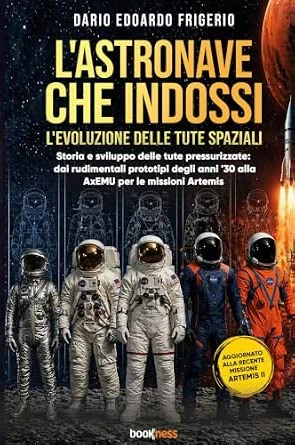
"L'astronave che indossi. L'evoluzione delle tute spaziali"
(by Dario Edoardo Frigerio - Bookness, in Italian; the title means "The spaceship you wear: the evolution of spacesuits"): The history and development of pressure suits, from the rudimentary prototypes of the 1930s to the AxEMU designed for the Artemis missions. A journey inside what is, to all intents and purposes, a small made-to-measure spaceship, the only thing standing between the astronaut and the vacuum, the cold and the radiation. The book is updated to the recent Artemis II mission. Available on Amazon.


RECOMMENDED DOCUMENTARIES AND FILMS
"Space Race"
"Space Race" (BBC): A spectacular docudrama retracing the ruthless Cold War space race through the titanic long-distance duel between two absolute geniuses of rocketry: Wernher von Braun for the United States and the top-secret "Chief Designer" Sergei Korolev for the Soviet Union. Combining a rigorous historical account with gripping cinematic storytelling, the series lays bare the triumphs, tragic failures and political obsessions that drove mankind all the way to the conquest of the Moon.
"From the Earth to the Moon"
"From the Earth to the Moon" (HBO): Produced by Tom Hanks and based on the meticulous history book by Andrew Chaikin, this monumental miniseries is the definitive screen adaptation of the Apollo program. It combines obsessive documentary rigor with powerful ensemble storytelling, celebrating not only the heroism of the astronauts in the void of space but also dissecting the titanic engineering challenges and human sacrifices faced by flight directors, technicians and families to turn mankind's greatest achievement into reality.
"Magnificent Desolation"
"Magnificent Desolation: Walking on the Moon 3D" (Produced by Tom Hanks): An extraordinary visual experience, originally designed for IMAX and named after the famous words Buzz Aldrin used to describe the lunar landscape. Skillfully mixing very rare NASA archive footage with spectacular computer-generated reconstructions, this documentary aims to physically transport the viewer onto the regolith. It is the definitive work for anyone who wants to feel the vertigo, the isolation and the absolute majesty of a real moonwalk, living the perfect illusion of walking side by side with the Apollo astronauts.
"Apollo 13"
"Apollo 13" (by Ron Howard): The definitive cinematic masterpiece that brought NASA's triumph of problem-solving to the big screen. With almost documentary technical rigor and historical accuracy, the film tells of the claustrophobic tension and desperate teamwork that turned a deadly cosmic disaster into the agency's "most successful failure". A must-see work that brilliantly shows how, in the lunar epic, the harsh reality of the facts is infinitely more gripping and spectacular than any Hollywood fiction.
"Capricorn One"
"Capricorn One" (by Peter Hyams): A famous 1977 political thriller that imagines the desperate staging of a fake landing on Mars. The plot is a Swiss watch of paranoia: minutes before launch, NASA discovers a fatal flaw in the spacecraft's life support system. To avoid public humiliation, budget cuts and the collapse of the entire space program, the three astronauts are secretly taken out of the capsule and moved to an isolated military base in the desert. There, under brutal threats of retaliation against their families, they are forced to act out the descent onto the Martian surface on a television set, while the real spacecraft travels empty through space. The deception seems to hold, until the automated capsule accidentally disintegrates during reentry into Earth's atmosphere. Officially declared "dead" in the eyes of the world, the astronauts realize that the conspirators will have to eliminate them physically to protect the secret, triggering a ruthless, desperate manhunt in the desert, just as a stubborn investigative journalist begins to notice anomalies in the data and put the pieces of the puzzle together. Paradoxically, although deniers often hail this film as the visual manifesto of their theories, it ends up radically debunking the very feasibility of such a staging. By showing the insane, bloody and unstoppable spiral of murders and cover-ups needed to silence even a handful of people, the film implicitly demonstrates, by reductio ad absurdum, that it would have been logistically, humanly and statistically impossible to silence for half a century the more than 400,000 people who worked openly on the Apollo program, keeping such a colossal fraud hidden and covered up forever. An absolute must-see!
"In the Shadow of the Moon"
"In the Shadow of the Moon" (by David Sington, 2007): The perfect documentary for anyone who wants to look history in the eye. It gathers intimate, candid and direct interviews with almost all the surviving astronauts who traveled to the Moon (from Aldrin to Collins, by way of Cernan and Young). Hearing their voices, sensing their genuine wonder and the emotion in their eyes as they recall the experience of walking on another world is a very powerful human and psychological antidote to denialist cynicism.
"First Man"
"First Man" (by Damien Chazelle, 2018): An essential film for dismantling the conspiracy myth of the "easy, romanticized" moonwalk. Stepping into Neil Armstrong's intimate, tormented perspective, the film throws in our faces the physical brutality, the deafening noise, the extreme claustrophobia and the constant shadow of death that pervaded the X-15 tests, the Gemini program and Apollo. It shows without filters the immense engineering effort and the toll in blood paid to tame machines that literally seemed about to break apart at any moment.
"Mission Control: the unsung heroes of Apollo"
"Mission Control: The Unsung Heroes of Apollo" (by David Fairhead, 2017): Want to drive home and carve in stone the idea of the 400,000 people involved? This is the definitive documentary. The camera shifts the spotlight away from the astronauts to focus on the flight controllers in Houston: young men barely in their twenties armed with slide rules, pencils and nerves of steel, who managed the most terrifying crises hundreds of thousands of kilometers away. It masterfully shows the gigantic "human machine" behind the scenes, making the idea of a fraud orchestrated in silence even more absurd and ridiculous.


Free resources:
To dismantle once and for all the legend that space data is inaccessible, in this section we have assembled a real documentary arsenal freely available to anyone with a genuine wish to learn. Here you will find direct links to NASA's vast public historical archives, to the original very high resolution photographic databases and to the complete transcripts of the flight communications. In addition, in the download area, we have selected and made freely downloadable some of the most fascinating operations manuals, technical diagrams and official reports of the entire Apollo program. The designs and telemetry data that took us to the Moon were never kept secret: they have always been here, waiting to be studied. The mathematical and engineering truth is just a click away; all it takes is the intellectual honesty to drop your prejudices and start reading.
The Apollo mission press kits:
- Apollo 7
- Apollo 8
- Apollo 9
- Apollo 10
- Apollo 11
- Apollo 12
- Apollo 13
- Apollo 14
- Apollo 15
- Apollo 16
- Apollo 17
Reference manuals for the hardware:
- Saturn V Moon Rocket - News Reference Manual
- Apollo Command and Service Module (CSM) - News Reference Manual
- Lunar Module (LM) - News Reference Manual
- Lunar Rover (LRV) - News Reference Manual
- ALSEP - News Reference Manual
- PLSS - Portable Life Support Subsystem
Online resources on the Apollo program:
- Apollo Flight Journal
- Apollo Archive Pictures
- Apollo Audio Video
- Apollo Documents
- Apollo Spacecraft manuals
- Apollo Landing Site LRO Images
- Apollo 11 landing sequence
- Working on the Moon
Friends of www.siamoandatisullaluna.com (Italian sites):
- Luca Parmitano
- Samantha Cristoforetti
- Umberto Guidoni
- Paolo Nespoli
- Cicap
- Alberto Angela Official Page
- Massimo Polidoro Official Site
- Massimo Polidoro YouTube Channel
- Il disinformatico: by Paolo Attivissimo
- Complotti lunari: by Paolo Attivissimo
- Forumastronautico.it
- AstronautiNews
- Gruppo Astrofili Columbia
- ISAA - Italian Space and Astronautics Association
- Perle complottiste
- Diego Cuoghi: Moon Hoax? No, thanks!
- Teolab.it