The story of the anomalous horizon...
A much discussed fact, hailed by conspiracy theorists and often exploited by sensation-hungry TV shows, is the alleged anomaly of the lunar horizon in the photos of the Apollo missions. From their point of view, the line separating the ground from the blackness of space is suspiciously close to the photographed scene, as if to betray the presence of a painted backdrop in a cramped Hollywood studio. Conspiracy theorists also point to the frequent blurring of this horizon, which they consider irrefutable proof of a small film set in which the background, being only a few meters away, inevitably falls outside the lens's plane of focus. They also claim that it would have been impossible for NASA's simulators to recreate a believable horizon and that these visual "errors" are, all in all, the signature of the fraud ...
 The desert plain of the Sea of Tranquility, the historic Apollo 11 landing area, in July 1969. Astronaut Buzz Aldrin called it "magnificent desolation". The photo fully shows how alien the lunar horizon is: curved, very close and quickly blurring into the distance. Photo courtesy of NASA.
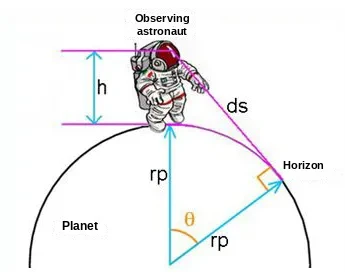
Those who support this theory show once again that they are fooled by their Earth-bound senses and know nothing about the laws of physics, geometry and optics that govern the appearance of an alien landscape. To debunk the myth of the too-close horizon, you only need to open a basic school geography book. The Earth's diameter is about 12,742 kilometers, while that of the Moon is just 3,474 kilometers. The ratio between the two sizes is obvious: the Moon is almost 4 times smaller than our planet (about 3.7 times, to be precise). Such a small celestial body inevitably has a much more pronounced surface curvature. There is a mathematical law, derived from the Pythagorean theorem, that unequivocally describes how far away the horizon line appears for an observer standing on the surface of a spherical body. The formula is:

where "ds" is the distance to the horizon, "rp" is the radius of the planet and "h" is the height of the observer's eyes above the ground. Applying this formula, the differences are immediately obvious! On Earth, taking the average eye height of an adult man as about 1.7 meters above the ground, the geometric horizon lies about 4.65 km away. On the Moon, with the same eye height above the ground, the rapid curvature means that the horizon drops to just 2.43 kilometers. This means that the lunar horizon appears almost twice as close as the Earth's (4.65 / 2.43 = about 1.91 times). The closeness of the lunar horizon in the Apollo photos is therefore an absolutely normal consequence that depends entirely on the size of the celestial body, and there is nothing anomalous about it! On the contrary! It is exactly what you would expect to photograph in those conditions ...
This oppressive closeness of the horizon was noticed immediately by the crews. Buzz Aldrin himself, once he set foot on the lunar surface during the Apollo 11 mission, pointed this out over the radio to Mission Control in Houston: "Gee, there's no doubt we're on a sphere!", noting how the surface took on a distinctly curved appearance as soon as he looked into the distance. This drastic geometric reduction combines with a visual phenomenon that literally short-circuits our brain: the complete absence of aerial perspective! On Earth, the atmosphere is full of moisture and dust that scatter light, creating a bluish haze that progressively envelops distant objects. This "atmospheric degradation" is the unconscious yardstick we use to judge whether a mountain is two or twenty kilometers away.
 Detail of a mountain landscape on Earth. Note how the atmosphere fading into the distance, and its humidity, make it easy to estimate distances, or at least to tell which objects are closer and which are farther away.
In the lunar vacuum this haze simply does not exist! A hill on the horizon two kilometers away shows the exact same contrast and the same incredible sharpness as a boulder a few meters from the astronaut. Without the cues provided by air, relief features flatten out in perspective and distances become impossible to judge with the naked eye, helping to create the optical illusion of a closed, artificial environment.
 Photo mosaic of the Apollo 17 landing area. Note how hard it is overall to estimate distances in the vacuum of the lunar environment, where distant details are as sharp as nearby ones.
That leaves the last point raised by the critics: why, if the horizon is more than two kilometers away, does it look noticeably blurred in many photos? The answer is not a film backdrop, but the strict mechanics of the Hasselblad 500EL cameras used on the Moon. Fitted with excellent 60 mm Zeiss Biogon lenses, these cameras were firmly attached to the chest of the A7L spacesuits. Because of the bulky pressurized helmet, the astronauts could not bring their eye to the viewfinder to compose the image or focus with millimeter precision. They had to "shoot blind", relying on a lens focus ring with three preset click-stop positions: near, medium and infinity.


When they photographed a crewmate, the Rover or the flag a few meters away, they set the focus ring to the near distance and stopped down the aperture to make the most of the depth of field. The laws of optics, however, are unforgiving: if focus is fixed at 3 or 5 meters, the hyperfocal distance will never be enough to keep infinity in perfect focus as well. As a result, while the spacesuit in the foreground is crisp and full of detail, the horizon line and the hills behind fall, mathematically, outside the zone of maximum sharpness, looking naturally soft and blurred.
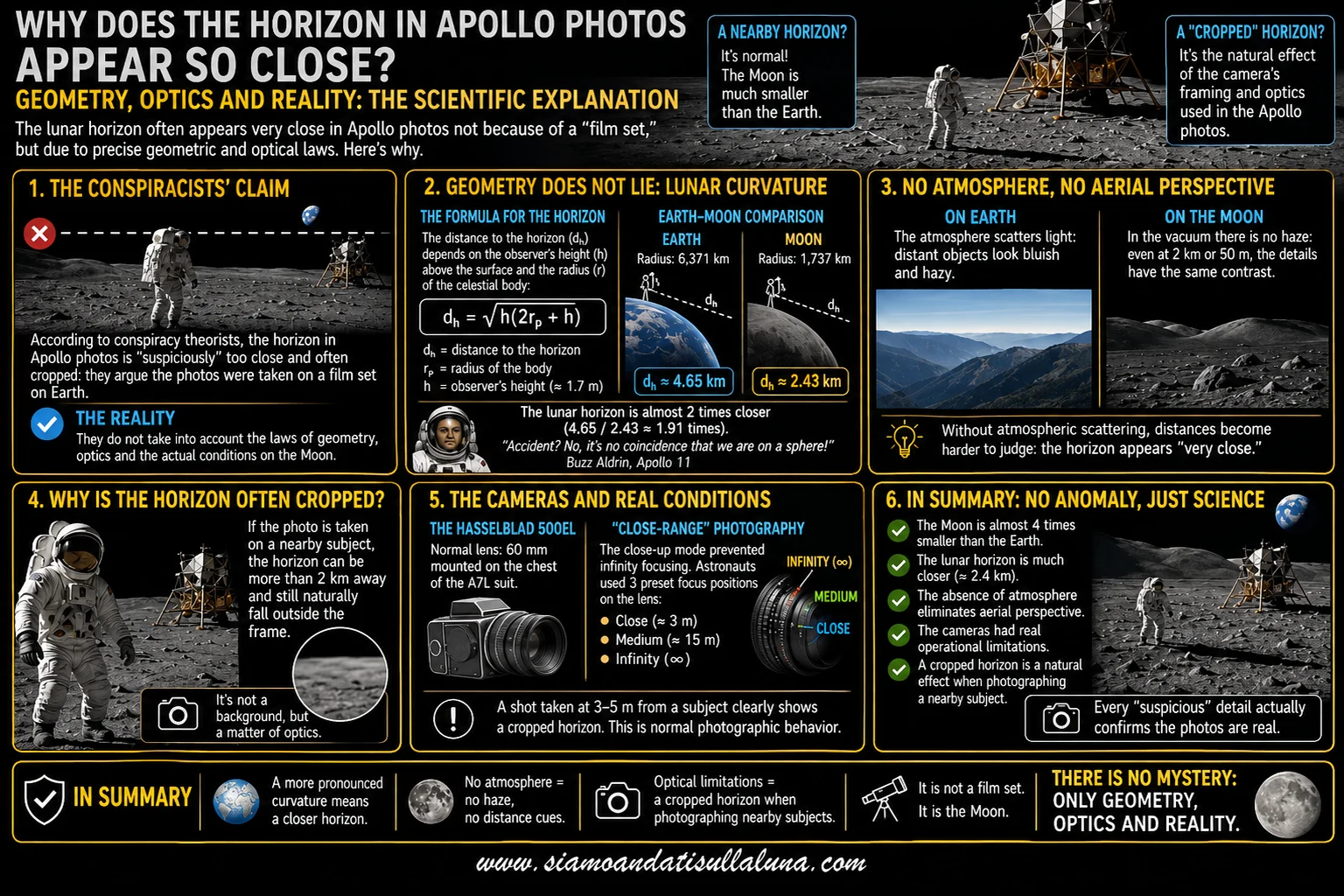
In conclusion, the close horizon and the way it appears in photos are not the clumsy mistakes of a low-budget Hollywood director, but the inevitable, rigorous consequences of an environment governed by strictly calculable geometric and photographic rules. Claiming to judge lunar images by the reassuring visual standards of Earth, a huge planet that we know very well, wrapped in a thick layer of gas, is the fundamental cognitive error that feeds every denialist theory. The details that conspiracy theorists triumphantly point to as proof of a staged hoax are, on the contrary, the most authentic and irrefutable scientific demonstrations that those historic photographs were taken exactly where NASA says: in the silent and dusty vacuum of the Moon!