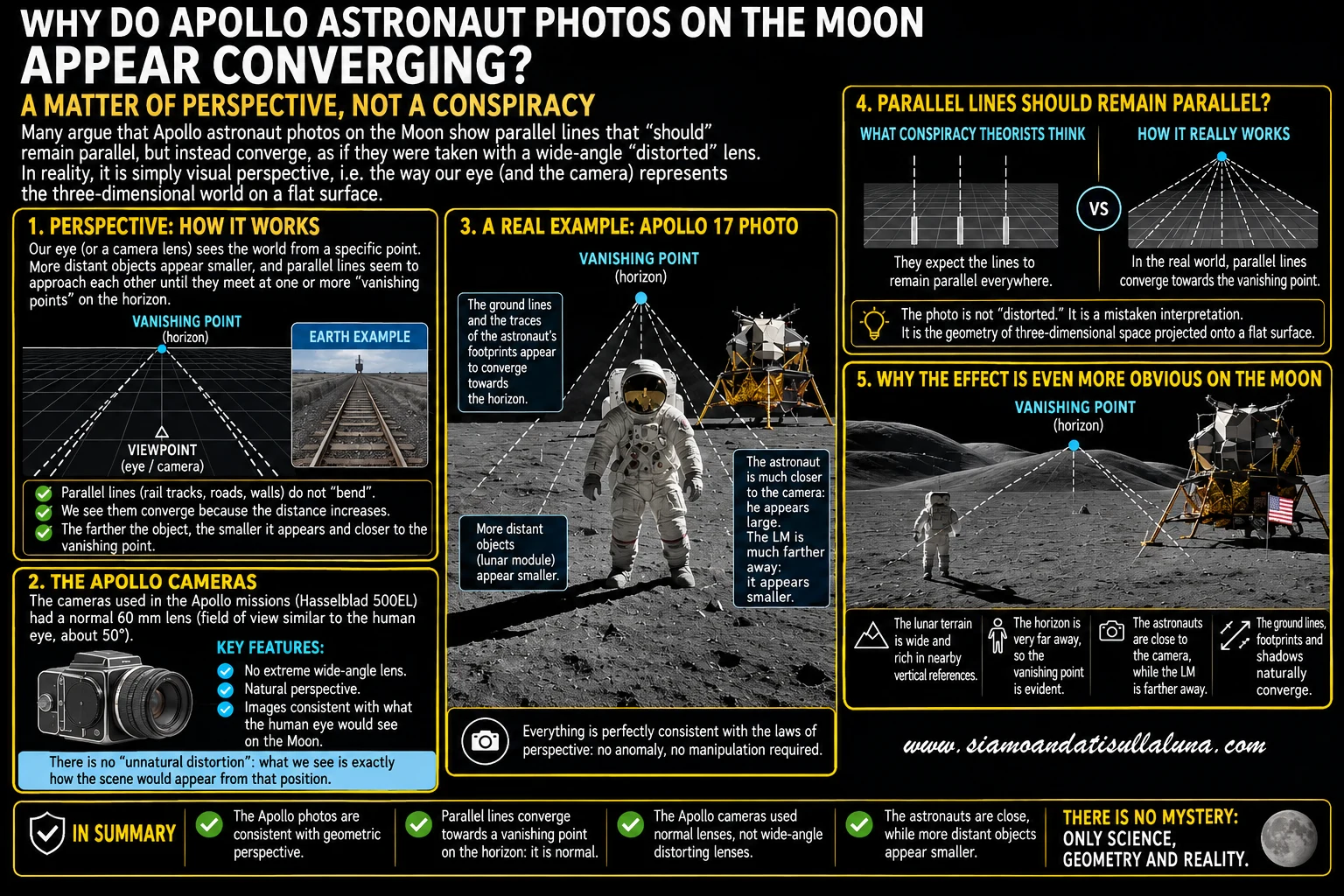
The story of the converging shadows ...
Let's continue our scientific analysis by carefully examining the alleged "problem" of anomalous or converging shadows which, according to conspiracy theorists, would undermine the authenticity of all the photographs of the Apollo program. According to deniers, in fact, the shadows on the lunar surface should be perfectly parallel to one another, since the Sun is the only light source and is located, "photographically speaking", at infinity. In the photos in question, however, they seem to converge or fall at different angles; this would prove that the scene was lit by multiple artificial light sources, placed in the immediate vicinity, just as would happen in a studio or on a movie set used to fake the missions.
This claim, however, completely ignores two fundamental factors that anyone with even a little experience of photography or of observing nature should know: perspective and the topography of the ground. Just as railroad tracks seem to converge toward the horizon even though they are parallel, perspective turns parallel lines into diagonals converging toward a vanishing point. If we add that the lunar soil is not a flat table but uneven terrain, full of bumps, dips and craters, it is easy to understand how the shadow of an object can appear distorted or "bent" depending on the slope of the dust it falls on.


If the photographs of the Apollo program had been taken on a set with artificial lights, as conspiracy theorists claim, the light sources would have had to be at an almost infinite distance so as not to give themselves away. The physics of lighting is relentless: every distinct light source must necessarily produce an equally distinct shadow. If there were several spotlights, every astronaut and every rock would cast several shadows on the ground. To understand this concept, just think of soccer games played at night. How many times have we noticed it watching them on television? The fields are lit as bright as day by huge floodlight towers placed at the four corners of the stadium, designed to send light from different directions. This system ensures visibility for the players and optimal television coverage, but it creates an unmistakable visual effect: every player casts three or four different shadows on the grass, spreading out from his feet like the rays of a star. If the Apollo program had been a cinematic hoax based on the use of several spotlights, as conspiracy theorists would have it, we should see exactly the same phenomenon. Instead, in every single photograph taken on the Moon, each object casts one and only one shadow! This unequivocally proves the presence of a single, extremely powerful light source located at an immense distance: the Sun. The multi-light set theory therefore collapses under the weight of a trivial optical fact that anyone can check in any stadium in the world.


And yet, looking with a critical eye at some shots taken during the Apollo program, an observer might reasonably ask: how can we explain the fact that lunar shadows sometimes seem to converge, diverge or point in apparently different and inconsistent directions? To answer effectively, we must remember that this phenomenon is not exclusive to the Moon. On Earth too, in a great many photographs, shadows seem to converge (as shown in photo A), diverge (photo B) or point in different directions (photo C). This happens because of visual perspective. Yes, exactly that basic notion we studied in our middle school art classes! According to the laws of perspective, lines that in reality are perfectly parallel tend to converge toward a single "vanishing point" when they are projected onto a two-dimensional plane such as a photograph. To this geometric effect we must add a decisive physical factor: the rough nature of the lunar soil. Shadows are not cast on a flat, smooth surface like the floor of a studio, but on uneven and distinctly rugged terrain. When the Sun is low on the horizon, shadows grow longer and tend to faithfully follow the slopes of the ground: if a shadow falls on a slight upward slope, it will seem to shorten or deviate; if it falls into a small hollow, it will seem to lengthen. It is this combination of perspective distortion and varying topography that creates the "anomalies" that conspiracy theorists mistake for errors on a movie set, but which are actually the clearest proof that the lunar environment is genuine and natural!


Since this visual perspective phenomenon inevitably appears every time we take a photograph here on Earth, it is perfectly logical that it should appear on the Moon as well. The Moon, as we have stressed many times, is not a magical realm with rules of its own, but a celestial body belonging to this very same Universe; it therefore obeys the same laws of physics and optics that govern our planet! Ignoring perspective in a lunar photo would be like being amazed that a stone falls downward on the lunar surface too: gravity and geometry do not stop at the edge of our atmosphere to do conspiracy theorists a favor!


But don't tell anyone! It seems that the phenomenon of crazy shadows on Earth and on the Moon, so hotly debated by landing deniers, shows up on Mars too! It was revealed to the world by NASA's rover Opportunity, whose spectacular panoramic shots of the deserts of the Red Planet once again highlighted, in spite of itself, the phenomenon of visual perspective. Too bad it didn't waste time taking backlit selfies just to show us the diverging shadows of Mars! But then, as everyone knows, that robot is millions of kilometers away from us for far nobler and more urgent purely scientific purposes, and certainly not to show certain inhabitants of Earth what they should have known since middle school ... Physics is a universal law and spares no one, not even among the iron oxide dunes of the fourth planet of the Solar System ...


To sum up, then, the apparently strange behavior of the shadows is not an unsolved anomaly or, even worse, a "suspicious" one, as conspiracy theorists would have us believe. Quite the contrary! It is simply what one would expect from a photo taken in full awareness of visual perspective, something that anyone with a camera (even a smartphone camera) can check at any time. Try it and see! In conclusion, it must be said that the apparent lack of parallelism of the shadows is due to the distortion that occurs when a three-dimensional scene (the reality being photographed) is viewed in a photograph that reproduces it in two dimensions. If you watch the footage (or frames from the footage) of the Apollo 11 astronauts, filmed from above by a camera placed behind one of the LM's two triangular windows, you will notice that the much-debated shadows are always perfectly parallel to one another! This is because the "high-angle shot" tends to add a certain three-dimensionality to the scene being observed. It should also be said that a shadow behind an object, whatever it may be, follows the unevenness of the ground it falls on, introducing an additional distortion to its theoretical direction. A shadow that has undergone this distortion, however, is easy to identify. It looks shorter than it should be if it extended over an ideally smooth plane. We must never forget, in fact, that the Apollo shadows were all captured on a surface tormented by intense meteoritic bombardment and for this very reason they show the unmistakable signs just described.
Everything said so far can therefore be summed up in a handy concluding slide ...