The story of the Lunar Rover that couldn't fit in the LM...
 Among the many logical short circuits that plague the denialist narrative, one of the most common and superficially "intellectual" concerns the Lunar Roving Vehicle (LRV), the famous electric off-road vehicle used on the last three Apollo missions. The conspiracy argument, based as always on a trivial visual observation and completely lacking any technical investigation, boils down to a question asked with barely concealed triumph: how could a three-meter car be squeezed inside that space "contraption", the Lunar Module? The fatal flaw in this objection lies in measuring 1970s aerospace technology by the yardstick of the automotive industry on Earth. The Lunar Rover was not a car in the traditional sense of the word, but one of the most extraordinary and complex examples of engineering origami in human history. Designed by Boeing together with the defense laboratories of General Motors, the LRV did not travel assembled and ready to use in the cabin with the astronauts at all, but was stowed outside, folded extremely compactly inside Quadrant 1, an unpressurized wedge-shaped bay in the LM Descent Stage. In this closed configuration, the vehicle formed an incredibly dense package measuring just 1.5 meters wide by 1.7 meters high and about half a meter thick, taking up a tiny overall volume. To fit it into such a cramped space, the chassis, originally 3.1 meters long with a wheelbase of 2.3 meters and built from ultra-high-strength 2219 aluminum alloy tubing, was divided into three hinged sections. During the trip to the Moon, the front and rear sections of the chassis were folded like a book onto the center section, while the four wheels (with tires made of an ingenious flexible mesh of woven wire and titanium treads) were squashed and folded inward, flat against the structure. Technically, the LRV was a triumph of redundancy and miniaturization: it had no central engine, but four independent 0.25-horsepower DC electric motors built directly into the hub of each wheel , with harmonic drive reducers with an 80:1 ratio.
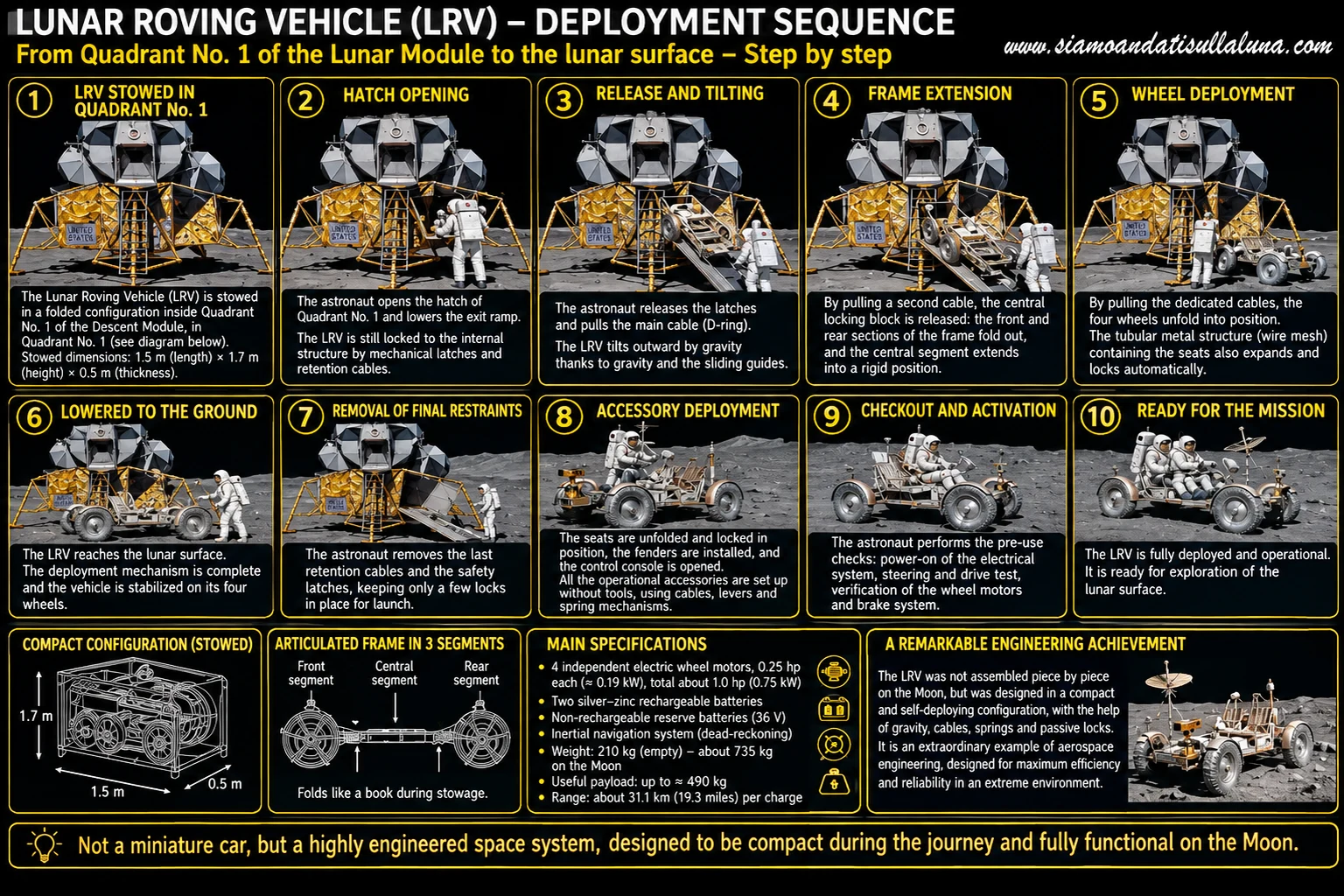
It also had independent dual steering on each axle, allowing it to turn almost on the spot, with a radius of just 3.1 meters; it was powered by two sealed, non-rechargeable silver-zinc batteries and guided by a gyroscopic inertial navigation system (dead reckoning) capable of constantly calculating the distance and heading back to the Lunar Module without any satellite assistance.


The whole vehicle, stripped of any unnecessary bodywork, weighed just 210 kilograms on Earth (which dropped to only 35 kilograms in the weak lunar gravity), yet it was built to carry a payload of almost twice its own weight. The deployment system was a masterpiece of passive kinematics: the astronauts did not have to assemble parts with wrenches or bolts, they simply pulled a specific sequence of cables, tapes and pulleys (the D-rings) while standing comfortably on the surface. By pulling these tethers in a precise order, gravity, preloaded springs and torsion bars did the rest. The Rover was released from its bay, tilted outward, the chassis sections unfolded and snapped rigidly into place and the wheels swung open automatically like a compass, locking before the vehicle touched the regolith, ready to be switched on and driven. Refusing to study and understand the genius of this hinged deployment mechanism , and trivially reducing everything to the impossibility of parking a compact car inside a spacecraft, does not in any way prove the existence of a government fraud; it only reveals the conspiracy theorists' complete inability to grasp the unbridgeable gap between ordinary everyday mechanics and the excellence of extreme aerospace engineering.