Attention! Before reading this section, we invite our visitors to read the explanatory article on how the cameras chosen for the Apollo program worked. You can find it in the blog section by clicking on the following link:
Hasselblad 500EL HDC, the cameras of the Apollo program
The story of the stars missing from the photographs ...
Let's start with the much-discussed "anomalous" photographs that the astronauts supposedly brought back from their missions on the lunar surface. One thing conspiracy theorists strongly contest is the total absence of stars. In fact, they say, the almost complete lack of atmosphere on our natural satellite would have been the "ne plus ultra" for taking beautiful daytime photos of these stars. Inexplicably, however, the stars appear nowhere, showing how NASA's degenerate conspirators, unable to reproduce with unquestionable accuracy, mission by mission, the position of all the stars visible in the sky at those moments, supposedly opted for a more sober and uniform black background, to be used forever on all the top-secret sets used for the hoax ... It must be said right away that anyone who ventures into this kind of claim shows, in my opinion, that they have never used a camera and, worse still, that they are speaking without any knowledge of photography whatsoever ...


 The photos of the Apollo missions are in fact starless because the lunar surface, at the time of the landings, was brightly lit by the Sun. This particular situation imposed, and would still impose today, specific conditions on the use of the cameras, especially if one wanted to get spectacular shots worthy of the name. It was like that in the Apollo era and it would still be like that today if we landed on our natural satellite again. In fact, despite all the things that have been said online, the truth is that there is no other scientific or logical explanation for the missing stars: it was daytime and, because of the strong sunlight, the stars could not be photographed, period! Whether you are on Earth, on the Moon or in space, when you want to photograph a very bright scene (such as a city at night, perhaps from the top of a hill), the question you face is always the same: do I want to correctly photograph the illuminated landscape, or the stars in the sky above it at that moment? Unfortunately, the two together can never be obtained in a single shot! They can be nowadays, perhaps, but only through later, complex computer processing with photo-editing software, by combining two separate shots: one taken with the specific aim of capturing the stars in the sky, the other, the landscape. The individual photos must be obtained using two equally distinct techniques: a "very fast" exposure for the brightly lit subject (in this case the city, which must not appear overexposed) and a "very slow" exposure for the stars in the sky, which, being very faint subjects, need more time to gather light on the film and become visible in the shot.


In the images above you can see two separate shots taken at night, under a perfectly clear sky, with the specific aim of capturing the town of Lampedusa from the roof of a house on the outskirts. After placing the camera on a tripod, the town was photographed with two separate exposures. The photo on the left was taken with a correct exposure time of just half a second. As you can see, the details of the town are all perfectly resolved, while the sky is pitch black. In the photo on the right, on the other hand, the same subject was taken with a full 5-second exposure with the specific aim of also capturing the stars that were shining in the sky at that moment; the experiment was a complete success! The stars of the constellation Sagittarius have magically appeared, but the town below has been saturated by photographic overexposure, which, although it made the image more spectacular, clearly wiped out most of the details that were easy to make out before. This shot easily shows what we have said so far: it is not possible to get a perfect photograph if you insist on mixing two subjects with very different lighting! If both subjects are brightly lit, the results can be disastrous for the final outcome of the shot. If both subjects are dimly lit, on the other hand, it can be done, but only through complex photographic processing that makes it possible to overlay the two individual shots, "adding" them together. To do this, of course, you need powerful photo-editing software, but the results, however unnatural, can also be spectacular ...
Below you can see the overlay of the two images above made with photopea by our staff ...

In the Apollo era, getting combined photos like the one above was pure science fiction! In those years, in fact, there were only manual, rudimentary photomontage techniques, whose results could look spectacular to an audience of the time (see the footage of 2001: A Space Odyssey), but would certainly not have fooled the eyes of today's science, today's best-trained experts, or the software analysis tools available today. Computer graphics (CGI), moreover, is in every respect an achievement of the last few decades, made possible only when technology allowed the development of the first powerful microprocessors, which at the time of man's conquest of the Moon were still far from being conceived ...
So why don't stars appear in the Apollo photos? The answer must be sought, as usual, in optical physics and, inevitably, in the chemical behavior of old photographic emulsions.
Since, as conspiracy theorists say, "the absence of atmosphere on the Moon should make the stars shine twice as bright, making them clearly visible in photographs even in the Sun's daylight", in these cases we have to remind them that "the Sun itself is a star" and, being hundreds of thousands of times closer to the Moon than the stars in the sky, it inevitably also gives off twice as much light! It is therefore clear that on the lunar surface, during the day, a very intense Sun shines, so much so that NASA engineers had to take every necessary measure to protect the crews as well as possible from this powerful influence. One of these, for example, was the use of white spacesuits, a color essential to reflect most of the incident light radiation, always paired with shielded helmets with protective visors made with a thin gold coating, the same visors that, in all the Apollo photographs showing astronauts, distort the reflected images of the surrounding environment ...

 This special visor, very similar in function to the protective mask used by modern professional welders, was necessary precisely to cut down the heavy solar glare on the lunar surface, acting as a kind of very dark sunglasses which, besides effectively filtering visible light and harmful incident radiation (mainly ultraviolet and infrared), allowed the astronauts to move safely even against the light. Anyone with even a basic knowledge of photography knows very well by now that taking good shots in extremely bright conditions is never a simple matter! Nor was it in the days of the Apollo missions, when the astronauts with their manual cameras, the Hasselblad 500EL HDC, in order to get satisfactory results with their shots, sometimes had to consult the technicians of Mission Control in Houston (MCC) to get the correct settings for their cameras (shutter speeds and apertures, depending on the subject to be photographed and its position relative to the Sun or the shadow).
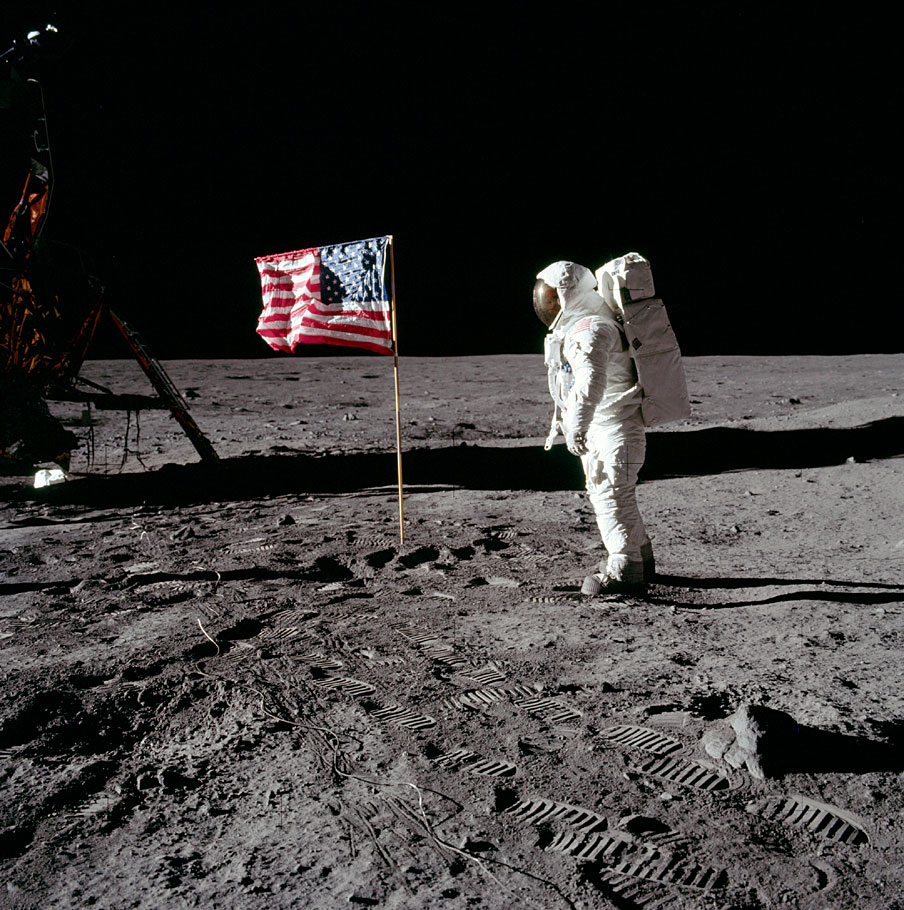
To get a shot worthy of the name, in fact, you have to expose the chemical film to a calibrated dose of light, which allows it to record the subject you have chosen to capture as faithfully as possible. To do this, you have to set the shutter speed correctly, which corresponds to the moment in which a device inside the camera, called the "shutter", opens and closes to let in the light for the photograph, for a longer or shorter time. The shutter speed is always chosen according to the aperture of the lens being used, which, besides effectively regulating the amount of light that enters the lens and reaches the film when the shutter opens, also determines the depth of field of the image, that is, how much the background in the foreground or the distance will appear more or less in focus in the overall image, around the main subject. Finally, another very important parameter is the chemical sensitivity of the chosen photographic film, which is always expressed in ISO. When these parameters are properly calibrated with one another, they allow a correct exposure of the chosen image on the film. It follows that if I want to photograph a brightly lit subject, such as an astronaut on the Moon next to his country's flag, I will necessarily have to use a carefully chosen shutter speed. Since I want to capture him together with the landscape in the background, I will set the aperture accordingly, so as to get an opening suitable for also bringing into focus the nearby lunar module, as well as part of the distant horizon. These are the considerations that Neil A. Armstrong, commander of the Apollo 11 mission, had to make when he took the historic photo of his colleague Edwin "Buzz" Aldrin standing at attention next to the American flag. The shot, later cataloged by NASA as AS11-40-5875, became an icon of the historic lunar mission and you can see it below, as a demonstration of what we have said so far and of the commander's excellent choice of shutter speed and aperture.


What is the aperture of a lens? The diaphragm is simply a blade mechanism inside the lens whose wider or narrower opening controls how much light of the shot will reach, and therefore expose, the photographic film. Its function basically mirrors that of the iris in the eye. Its opening determines the f-number (focal ratio) with which the shot will be taken. A small aperture makes it possible to photograph very bright scenes at the expense of very faint details such as stars; a wide aperture does the opposite.
As you can see in the original photo in the center, the astronaut and the background objects appear perfectly in focus, showing the correct choice of aperture; the smallest details are resolved and the details of the spacesuit perfectly visible, despite the strong incident sunlight, also showing the choice of the correct shutter speed. The sky in the background, moreover, is pitch black, in accordance with the laws of physics , which dictate that even in the total absence of atmosphere and in an environment brightly lit by the Sun, the choice of a very short shutter speed (in this case 1/250 of a second) does not allow faint objects such as stars to record their dim light on the film!
For that to happen, much longer exposure times would in fact be needed. But what would that mean? The example below shows it!
The photo on the left shows how frame AS11-40-5875 would look if it had been taken with an underestimated exposure time, with a correct exposure time in the center, and with an overestimated one in the demonstration photo on the right ...


The three images above clearly show the crucial impact of shutter speed on the final result of the shot. If the exposure time is underestimated, the film receives an insufficient amount of light: the result is a dark image, whose details sink into darkness in what is technically called underexposure. On the contrary, by overestimating the shutter time, light floods the film, saturating the whites and literally "eating away" the outlines of objects. In this case the photo appears overexposed or, more commonly, "burned out". Looking carefully at the deep black sky in an overexposed shot, however, you can notice a surprising detail: the darkness is dotted with faint traces of light that in correctly exposed shots are invisible. Those blurry white dots are the faint imprint of the brightest stars, which have finally managed to register on the film thanks to the long opening of the shutter. But at what price? The attempt to capture starlight makes it impossible to capture the real protagonists of the scene: the astronaut, the flag and the lunar module appear as ghostly, indistinguishable silhouettes, overwhelmed by the general glare of the Sun. Clearly, a NASA technician would have immediately discarded such a frame when developing the film, depriving us of the iconic images that are now part of mankind's collective memory. This example explains, simply and definitively, why no stars can be seen in the famous photos of the Apollo program: NASA and the astronauts were not interested in photographing them. Capturing the night sky was not among the scientific objectives of the mission! The crews spent months training under the guidance of the best photographers in the country precisely to avoid mistakes; their task was to get flawless frames of the lunar surface in the very little time available. Every minute spent on the Moon was a frantic race against the clock and there was no room for "trifles" like astronomical photography of the background. Flying to the Moon was an undertaking of  astronomical cost. The Apollo program required an investment of about 25.8 billion dollars at the time, which adjusted for inflation today exceed 250 billion. Such a sum carried an enormous responsibility: every mission had to ensure the greatest possible scientific return. The astronauts had to deploy complex experiment packages (ALSEP), seismometers and dust detectors, collect geological samples and document canyons, craters and rocks with extreme precision. In an environment as harshly lit as the lunar surface, the risk of getting
 the exposure wrong was constant. Unlike today, when smartphones and digital cameras let you check the shot instantly on a high-definition display, back then the results were a complete unknown. The "truth" only emerged once they were back on Earth, in NASA's processing laboratories. This uncertainty justified the extreme concern in choosing the exposure settings: ruining a roll of film meant losing unrepeatable data. And, as is easy to see, going back to the Moon to retake a blurry or burned-out photo would have been a far too expensive luxury. If the astronauts had wanted to photograph the stars, they could easily have done so, but in a completely different way from what conspiracy theorists imagine. They would simply have had to stand in the shadow of the LM (and therefore away from the strong solar glare), point the camera at the sky, perhaps on a tripod to avoid blurred photos, and finally take an exposure of a few seconds. All this was actually done during the Apollo 16 mission, when astronauts John Young and Charlie Duke deployed a real catadioptric telescope, the Far Ultraviolet Camera/Spectrograph, one of the scientific experiments taken to the Moon and fitted with a camera using ultraviolet-sensitive film. The purpose of the experiment was to take some photos of planet Earth (which always appeared stationary at the same point in the lunar sky), of the stars and of the Milky Way. The possibility of getting photographs of these objects without the shimmering imposed by the turbulence of Earth's atmosphere (seeing) had in fact long intrigued NASA's astronomers. The astronauts operated this telescope in their spare moments, and it produced important results in the study of the physics of Earth's atmosphere. The photo on the right is a shot taken by this telescope and shows the Earth as it appeared in ultraviolet light from the Descartes highlands during the Apollo 16 mission in April 1972. This photo has also been analyzed recently by a team of scientists to verify its authenticity. The position of the planet, seen in phase against the background stars, is flawless, fully proving that the shot is genuine and where it came from.
It is also essential to stress that the phenomenon of the missing stars in the snapshots taken by the Apollo astronauts does not concern only the old Hasselblad films of the 1960s. If we look at the photographs taken in modern times by astronauts aboard the International Space Station or during the Shuttle missions (think of the shots by Luca Parmitano, Samantha Cristoforetti or Umberto Guidoni), we will notice that the sky always appears as a deep black, starless abyss. At this point, logic speaks clearly: supporting the conspiracy claim of the "missing stars" would mean claiming that all the European astronauts and international space agencies are also accomplices in a planetary staging orchestrated by NASA. Such a deduction is a baseless enormity which would paradoxically lead to denying not only the Moon landings, but even the human presence in Earth orbit over the last sixty years. Clearly, here the conspiracy theory stops being a legitimate doubt and turns into an irrational exaggeration that deliberately ignores the basics of modern optical physics.


 Photo courtesy: http://www.apolloarchive.com/Browsing the web, I have never come across a conspiracy theorist who "personally took a stand" by commenting on photographs recently taken in Earth orbit. And yet, the shooting conditions are identical to those on the Moon: no atmosphere, a pitch-black sky and blinding sunlight! In these modern shots too, the stars are missing! They are missing for an elementary physical reason: photographic film (or a digital sensor) does not have the dynamic range of the human eye. If the goal is to get a clearly visible, correctly exposed main subject, technical compromises must inevitably be accepted , which inevitably lead to the exclusion of faint background details. In reality, though, the stars are always there! In the photo on the left, deliberately taken with slight overexposure to demonstrate this concept, the stars appear in all their brightness. However, a problem is immediately apparent: they appear blurred because of the combined effect of orbital motion and P.T.C. (Passive Thermal Control). In this shot, besides the stars, the outermost layer of Earth's atmosphere is also visible, but because of the long exposure time needed to record the starlight, the details of the spacecraft and of the Earth's surface are inevitably blurred. As explained earlier, spectacular photos are possible, but only by coming to terms with the laws of optical physics. A masterly example of this balance can be found in the photo on the right: the Saturn V rocket lifts off from the Kennedy Space Center for the last time in its lunar configuration. It is the start of the Apollo 17 mission, the last crewed ark to fly to the Moon. The exposure, lasting a full 2 minutes and taken from the nearby town of Cocoa Beach, captures the long fiery trail of the five powerful F-1 engines of the first stage. Around the trail, the stars appear slightly blurred against a deep red sky, an effect due both to the flames from the giant and to the overexposure needed to get this iconic shot.
 NASA recently released the splendid photos from the Artemis II mission, with astronauts Koch, Glover, Hansen and Wiseman on board, the first mission since Apollo 17 in 1972 to leave Earth again for the Moon (April 1, 2026). This photo shows the night side of the Earth, deliberately overexposed to bring out the planet's surface details. By exposing the Earth for several seconds, the continents lit by the full Moon appeared, along with the surface details of European cities, the upper atmosphere, the auroras at the poles and, even more spectacular, the stars and the planets of the solar system that were near the Sun(here hidden by the bulk of the Earth) at that moment. Photo courtesy NASA.
 Another spectacular Artemis II photo showing the far side of the Moon during the Orion spacecraft's close flyby. The Moon's bulk hides the disk of the Sun, creating a spectacular eclipse reserved for the astronauts. Without the most blinding and fierce part of the solar glare (only the corona is visible), the camera, set to a longer exposure, managed to capture the stars and planets of the solar system that stood out in the sky at that moment. Photo courtesy NASA.
 Although more than 50 years have passed since the premature end of the Apollo program, the Artemis II astronauts have shown that optical physics is always the same and, although photographic techniques have improved thanks to digital electronics, a digital sensor is still unable to capture the Earth and the Moon, lit by heavy solar glare, against a star-studded sky. Quite the contrary! The exposure times, set for the obvious planetary subjects in the foreground, unmistakably show a pitch-black sky in the background! Just like in 1968, in the days of Apollo 8 ... Photo courtesy NASA.
These photos are the definitive proof of what this chapter has argued: the stars are always there, but to see them in photographs you have to do one of two things: choose the most suitable time and place to photograph them, or make them the main subject of the shot! Otherwise they won't show up!