The story of the mysterious lunar music...

Another fertile ground for conspiracy speculation, hovering between the paranormal and science fiction, is the so-called "space music" or "radio howls" heard by the crews of Apollo 10 and (something conspiracy theorists are unaware of) Apollo 11 while they were in orbit behind the far side of the Moon. The story only exploded in the media years later, when the tapes of the Apollo 10 mission were made public, in which astronauts Tom Stafford, Eugene Cernan and John Young can be heard commenting in amazement on a hissing, modulated sound, like an electronic whistle, that lasted for almost an hour while they were cut off from  communications with Earth. This phenomenon quickly became a pillar for that particular branch of conspiracy thinking that does not necessarily deny the landing, but claims that NASA is hiding evidence of extraterrestrial contact or of ancient alien bases on the lunar surface. The landscape of Moon conspiracy theories is in fact extremely varied and is not a monolithic bloc. On one side there are the "total deniers", convinced that no mission ever left Earth orbit and that everything was filmed in movie studios on Earth. On the other are more moderate currents, such as those who consider only the "Apollo 11" mission fake , staged, in their view, purely for political propaganda, while accepting that the later ones were genuine. Finally, there is the line of thought of the "alien cover-up theorists", who believe that the astronauts really did reach the Moon, but found non-human structures or entities, and that the radio noises they heard are proof of intercepted extraterrestrial transmissions or of interference signals coming from installations hidden in the craters of the far side. In short, there's something for everyone! The scientific and technical explanation, however, is a far cry from UFO fantasies and lies in the physics of radio interference between spacecraft. During the lunar orbit phases, the Command Module (CSM) and the Lunar Module (LM) each had their own independent transceivers operating on different but very close VHF radio frequencies. When the two vehicles were a short distance apart or maneuvering close to each other, the radio waves produced by the two systems went into a state of interference known as "beating". Basically, if two radio signals have slightly different frequencies, their overlap creates a third signal whose frequency is equal to the difference between the two originals. If this difference falls within the audible spectrum (between 20 Hz and 20 kHz), the result is a modulated sound that the onboard electronics turn into a whistle or a howl audible in the astronauts' headsets. It is a phenomenon known since the dawn of amateur radio...
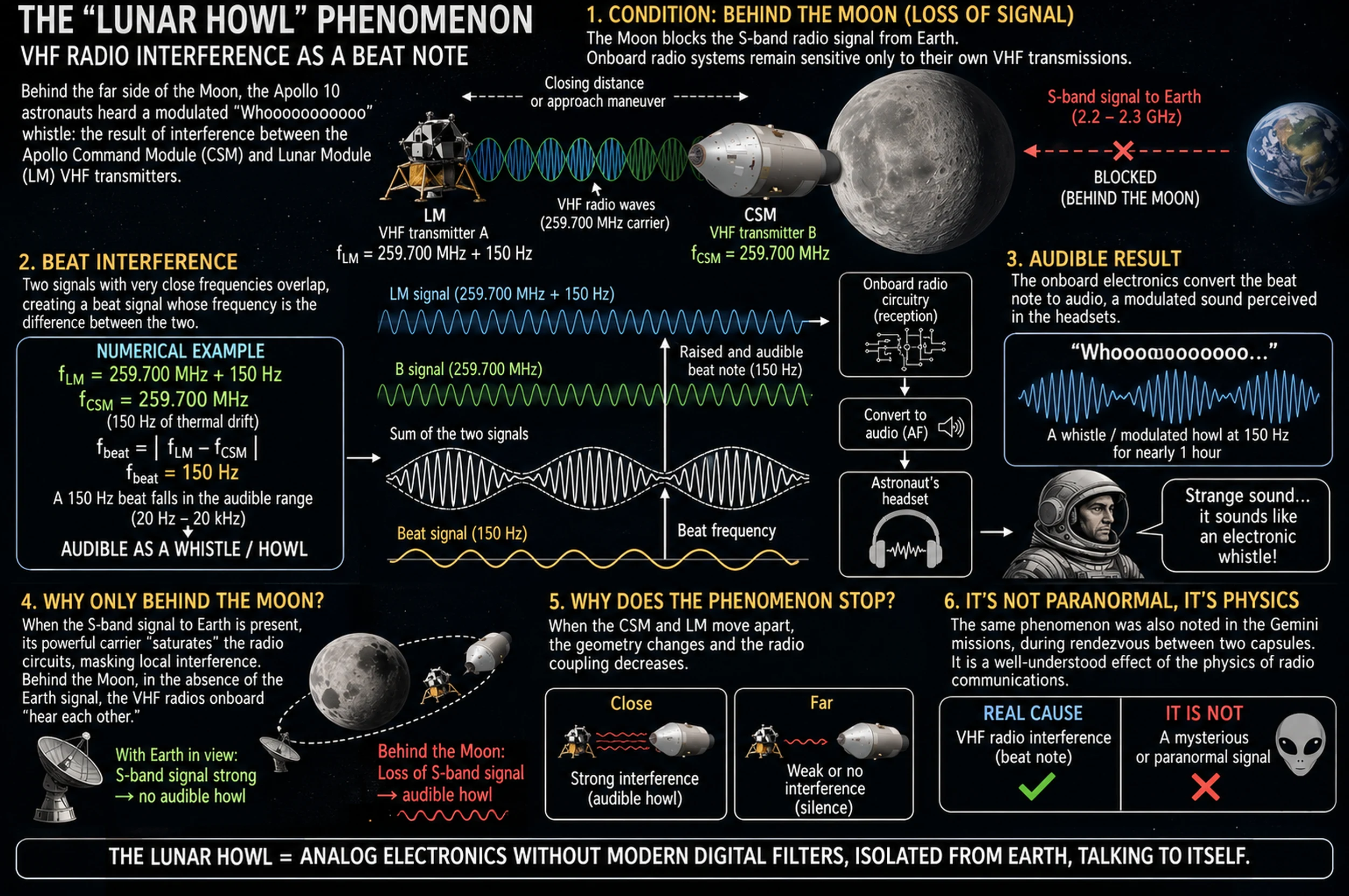
For the sake of scientific completeness, below are the transcripts of the radio communications between the Command Module "Charlie Brown" (with CMP John Young alone on board) and the Lunar Module "Snoopy" (with astronauts Tom Stafford - CDR and Eugene Cernan - LMP). It is clear that the crew were chatting jokingly on the radio, while the spacecraft had just separated in the hidden lunar orbit for the dress rehearsal of the landing. Suddenly, at 102:13:00 mission elapsed time, the mysterious sound appears out of nowhere in their headsets...
Original audio:
Original transcript:
 This attitude clearly shows that the astronauts had understood that the sound was beyond any doubt attributable to probable radio interference and that, in the overall context of the lunar descent that was about to begin, it certainly deserved less attention than the supercritical helium tank to be activated, needed to run the LM's descent engine (DPS). Not to mention the chocolate brownies and grape juice left in the Command Module, waiting for the crew to return from the landing rehearsal... The reason the phenomenon was heard only behind the Moon is that, in that zone, the radio signal from Earth was completely blocked by the mass of the Moon (LOS - Loss of Signal). Indeed, it should be pointed out that on the far side of our satellite there is no interference of terrestrial origin at all. None whatsoever! It is a zone of complete radio silence, where in the near future there are plans to install radio astronomy facilities precisely to study the sky at radio wavelengths, shielded from the powerful and often reckless broadcasters on Earth. For the Apollo missions, in the absence of the powerful carrier of the terrestrial S-band signal, which normally saturated the circuits, the onboard radio systems remained sensitive only to their own local VHF emissions, making the beating phenomenon much more pronounced. Since the Moon acted as a physical shield, this "electronic concert" could not be picked up in real time by the Earth antennas of the Deep Space Network, but was recorded only on the magnetic tapes of the onboard recorders (Data Storage Equipment), thus feeding, after the fact, the false myth of a secret kept in the silence of the far side of the Moon. The definitive proof of the technical nature of this "mystery" is that "the eerie whistle" stopped for good when the two modules moved farther apart, changing the geometry of the orbits and therefore the load on the radio circuits. Although the explanation was already known at the time of the Gemini missions (where very similar radio interference had occurred, especially during rendezvous between two capsules), conspiracy theorists continue to completely and deliberately ignore the physics of telecommunications, all for the sole purpose of feeding the fanciful, captivating narrative of alien contact. The "space music" of Apollo 10, however, is nothing more than the lament of analog electronics without modern active digital filters , which, isolated from the world and immersed in the electromagnetic silence of the far side of the Moon, ends up talking noisily to itself, producing a curious but perfectly explainable and reproducible effect, such as the lunar howls. Elevating mundane radio interference between two machines to proof of extraterrestrial contact is not only a scientific error but the symptom of desperate conspiracy thinking that always wants "mystery at all costs" and that, rather than accept the greatness of human ingenuity, prefers to take refuge in UFO folklore, mistaking the hum of circuits for the hostile voice of alien Moon bases. And as always in these cases, that alone is enough to make you laugh...