Warning! Before reading this section, we invite you to read the explanatory article on how the cameras chosen for the Apollo program worked. You can find it in the blog section by clicking on the following link:
Hasselblad 500EL HDC, the cameras of the Apollo program
The story of the gray shadows...
Another alleged anomaly, invoked with stubborn frequency by conspiracy theorists, concerns the lighting, and in particular the color and density of the shadows in the historic photographs taken on the lunar surface. The denialist objection rests on a seemingly logical but scientifically unfounded syllogism: there is no atmosphere on the Moon and, consequently, there is no suspended dust capable of scattering light; therefore, shadows should be absolutely black, pits of darkness without any detail. The fact that in the Apollo photos the shadowed areas of the astronauts and vehicles often look gray and full of visible detail would prove, according to them, the use of auxiliary studio lights on an air-filled set on Earth.


By carefully analyzing these claims and examining high-resolution scans of the original film rolls, the conspiracy scaffolding collapses under the weight of the basic laws of photographic optics and astronomy. First of all, we need to understand the technical limits of the equipment used. The Hasselblad cameras were manual instruments and the film had an exposure latitude, that is, the ability to record bright highlights and deep shadows at the same time, that was well defined and physically limited. When an astronaut took a photo in conditions of very strong incident light (for example against the light or with the Sun directly behind him), he had to set very short exposure times and stop the aperture down to its minimum so as not to "blow out" the main subject and make it unrecognizable. The inevitable photometric result of this selective underexposure is extreme contrast: the framed subject appears perfectly defined, while the surrounding shadows and the sky plunge into pitch black, wiping out every detail of the ground not directly lit. Conversely, when the frame moved to subjects lit from the side or when they deliberately tried to capture details in less exposed areas, the astronauts opened the aperture and lengthened the exposure time. By letting much more light reach the chemical emulsion, details in the shadows that were previously invisible emerged as shades of gray. It is a simple matter of exposure compensation, a technical compromise familiar to any photographer who has to work in environments with extreme contrast. Added to this optical dynamic is the very nature of the photographic media used. The phenomenon of shadows that look "gray" or "lightened" is much more pronounced in the shots taken on black-and-white film. Monochrome film, because of its specific chemical characteristics and the light-sensitive materials used, has a wider dynamic range and greater tolerance in dark areas than the color reversal films (slides) used for the most famous shots, in which color and brightness contrasts are chemically much harsher and sharper.
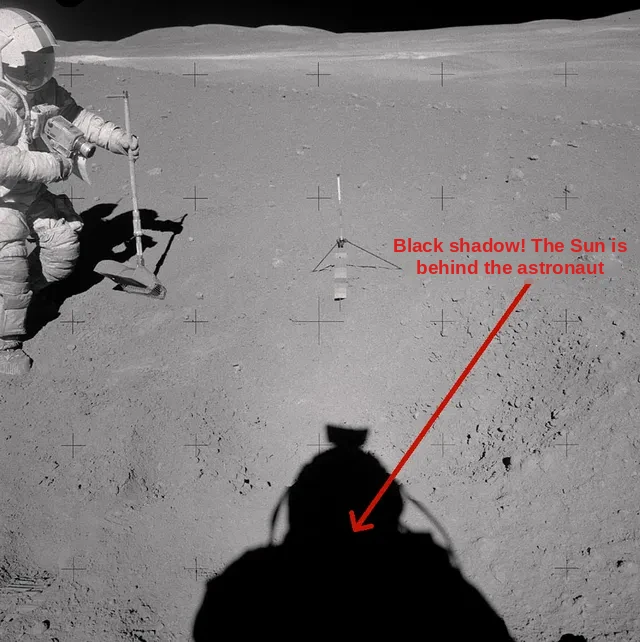
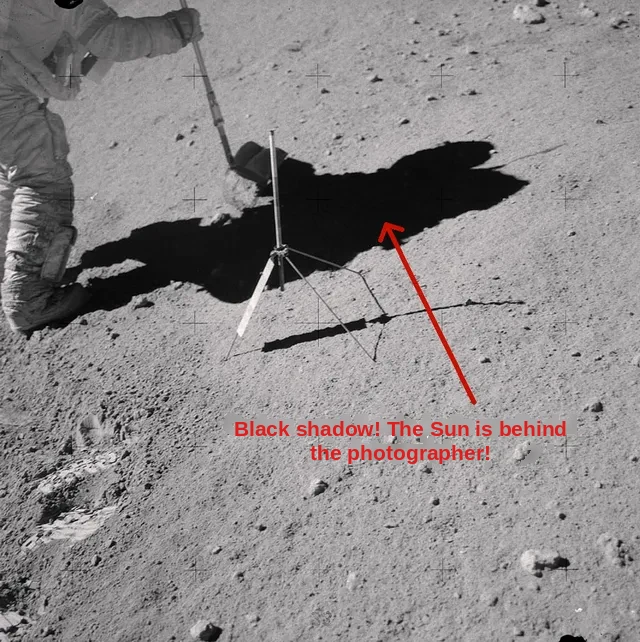
But the conspiracy theorists' most serious conceptual error is the childish assumption that light needs an atmosphere in order to travel or scatter. They overlook a colossal and ever-present factor: the lunar surface itself! The lunar ground, covered with a fine, light-colored regolith, acts as a gigantic, ever-present reflector panel. Sunlight hits the ground and bounces off in every direction, filling in and lighting the shadowed areas from below, such as the front of the suit of an astronaut with his back to the Sun. It is exactly the same principle by which we, at night, can find our way in the dark thanks to moonlight: our satellite reflects sunlight toward Earth traveling through the vacuum all the way to us across space. If light needed air to travel or be reflected, we would not see the Sun by day, and at night the cosmos would look completely black, with no Moon and no stars!


 To complete this formidable natural lighting scenario, there is a second, very powerful source of indirect light on the Moon that deniers systematically forget to mention: the Earth. Our satellite is in synchronous rotation, which means that it takes the same time to rotate on its axis as it does to orbit our planet, always showing us the same face. For an astronaut standing on the near side of the Moon, the Earth never rises or sets, but appears fixed and majestic above the horizon. And it is no faint little light. If the full Moon can cast sharp, visible shadows on Earth at night, let us imagine the reverse effect. The Earth's diameter is almost four times that of the Moon and most of its surface is covered by oceans, ice caps and swirling, brilliant white cloud formations that act as formidable mirrors. The amount of light reflected by our planet toward the Moon is monumental. This phenomenon is clearly visible from Earth a few days after the new Moon, when the part of the Moon not lit by the Sun at that moment appears faintly lit by a bluish glow (a phenomenon known as ashen light or "Earthshine"): it is light reflected by the Earth, bouncing off the lunar surface and coming back to our eyes! During the Apollo missions, this massive dose of Earthshine, combined with the blinding glare of the ground and with direct sunlight, created a radiant, multidirectional environment.
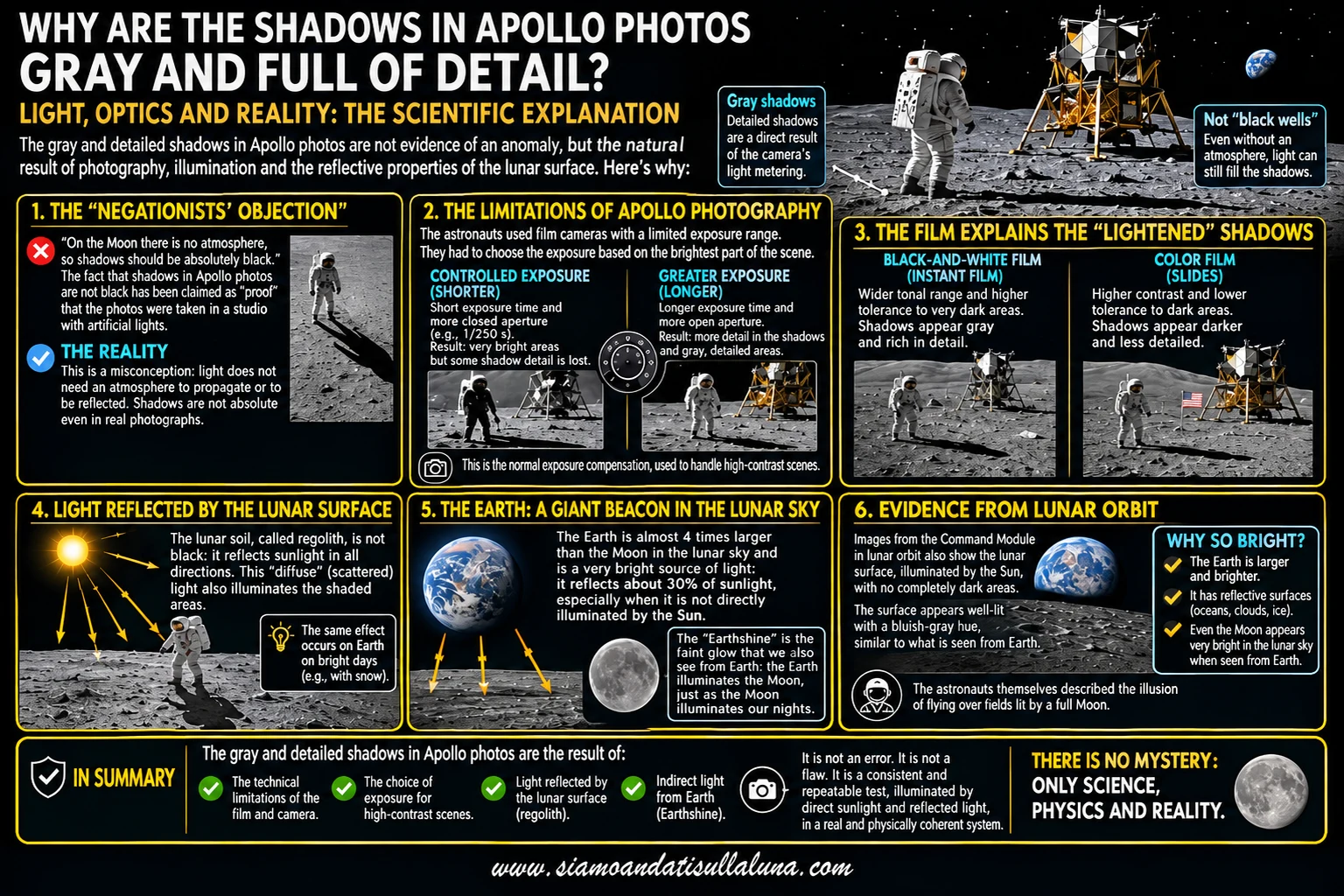
Further proof of how much light the Earth shed on the Moon comes from the accounts of the Apollo Command Module Pilots, the astronauts who did not land on the Moon but stayed in orbit waiting for their crewmates on the surface. When they flew over the lunar hemisphere facing the Earth but temporarily not lit by the Sun, they did not sink into absolute darkness at all. To understand how intense this phenomenon is, consider that in the lunar sky the Earth looks almost four times larger than the Moon does to us and, thanks to its highly reflective surface, has a surface brightness (albedo) much higher than that of the arid, dark regolith (whose reflectance is comparable to that of freshly laid asphalt). As a result, a "Full Earth" seen from lunar orbit shines dozens of times brighter than the familiar Full Moonwe are used to. Under this immense, silent blue beacon, the tormented landscapes of craters and basalt basins took on a ghostly, silvery glow, allowing the pilots to clearly make out topographic details. The astronauts described with wonder the optical illusion created by this reflected light: looking out of the Command Module windows during those night passes gave the exact, enchanting sensation of flying low over endless snowy fields on Earth lit by the glow of a full Moon. Contrary to what conspiracy theorists claim, therefore, the astronauts were not moving in a dark room lit by a single Hollywood spotlight, but in an open space flooded with direct and reflected cosmic light on a planetary scale. All this makes the presence of gray shadows full of detail not the clumsy mistake of a lighting technician, but the irrefutable and fascinating proof of planetary exploration in a deeply interconnected orbital system, in which the mutual reflection of the celestial bodies involved was anything but negligible.