The story of the missing LM crater...
 Another alleged irrefutable proof that the lunar missions were faked lies, according to conspiracy theorists, right under the belly of the Lunar Module. Looking at the photographs of the various landing sites, deniers triumphantly point out the complete absence of a blast crater under the nozzle of the descent engine (DPS - Descent Propulsion System). According to their logic, the devastating power of the scorching exhaust gases of a rocket engine, running flat out to brake and support the LEM during landing, should inevitably have dug a deep hole in the ground! Instead, the ground below looks inexplicably flat and free of dramatic upheaval, as if the spacecraft weighing several tons had been gently lowered from above by the ropes of a film-studio hoist. These claims, now a classic of conspiracy rhetoric, show a complete misunderstanding of the basics of space propulsion, of lunar geology and, above all, of fluid dynamics in the vacuum of space. To understand the origin of this deep-rooted visual prejudice, we need to go back to the early 1960s, when NASA presented to the public the preliminary artist's sketches of the Apollo program. In those early concept illustrations, artists had often drawn conspicuous smoking craters between the legs of the LM, assuming that the entire lunar surface was an ocean of soft dust tens of meters deep. The geological reality turned out to be very different and much more solid: under a very thin surface layer of dusty regolith (often only a few centimeters), the lunar ground consists of basalt rock that is extremely hard and compact. Digging a crater in a solid slab of volcanic rock takes much more than the momentary thrust of a rocket that is being shut down. The conspiracy theorists' second fundamental mistake concerns their assessment of the power delivered by the engine at the moment of touchdown. The LM descent engine was a masterpiece of engineering precisely because it was "throttleable", meaning that its thrust could be adjusted continuously as needed, exactly like pressing the accelerator pedal of a car.


 During the first phase of the descent to leave lunar orbit, the engine did indeed burn at full power to brake the vehicle's enormous orbital speed. However, as the LM got closer to the ground and slowed down, the power was drastically reduced. In the last moments of flight, when the vehicle hovered like a helicopter a few meters above the surface so the commander could look for a landing spot clear of craters and boulders, the engine was delivering only 25-30% of its maximum thrust. Add to this the reduced lunar gravity. On the Moon, in fact, the Lunar Module did not weigh 15 tons as on Earth, but just over 2,500 kilograms. To support that weight and lower it gently in the vacuum took relatively modest thrust, completely incapable of shattering the rock below. For a comparison on Earth, military vertical take-off jets such as the Harrier routinely land on asphalt runways or aircraft carrier decks supporting a similar weight in six times the gravity, and yet their extremely powerful concentrated jets dig no hole under the aircraft!
But the most decisive factor in explaining the missing crater is, once again, the complete lack of atmosphere. On Earth, the pressure of the surrounding air compresses and "squeezes" a rocket's exhaust gases, confining them to a narrow, concentrated and devastating column of fire like the flame of an oxy-acetylene torch, capable of cutting into the ground. In the lunar vacuum, with no atmospheric pressure, this aerodynamic confinement does not exist. As soon as the exhaust gases pass the rim of the engine bell, they instantly expand in all directions, taking the shape of a very wide, very low-density fan. As they expand radially, the gas pressure per square centimeter drops dramatically and, according to the principles of thermodynamics, their temperature plunges. What hits the lunar surface in the last meters of the descent is not a concentrated laser beam, but a dispersed, radial puff that violently sweeps away the surface layer of dust, but has neither the mechanical density nor the thermal energy to dig into rock.


 The DPS engine of Apollo 14's LM "Antares". In this detailed photo you can see the effect of the DPS engine on the lunar surface, which appears swept clean down to the bare rock under the surface regolith. The radial dispersion of the jet and the cracking of the basalt layer caused by the heat are clearly visible on the ground. Photo courtesy of NASA.
Closely connected to this merciless logic of the vacuum is another recurring accusation: the mystery of the perfectly clean LM footpads... Critics wonder how it is possible that, landing on dusty ground with a rocket firing, the vehicle's wide gold footpads were not covered by a thick layer of debris. Science's answer to this demolishes the far-fetched idea of a film set on Earth in a single stroke! On Earth, in fact, the air is stirred up by the exhaust gases, creating convection currents and turbulence that lift the dust into swirling clouds; these clouds stay suspended for minutes before settling gently on everything below, the vehicle included. On the Moon, there is no air! Being in the vacuum of space, the engine gases swept the dust away only radially, firing it parallel to the ground at very high speed. The dust traveled straight and flat, never rising in billowing clouds (how could it?), falling back ballistically tens of meters away. In addition, from the LM's footpads hung contact probes about a meter and a half long. When the first of these probes brushed the ground, on the LM control console in front of the crew a pair of blue lights came on at the same time ("Contact Light"). At that signal, procedure required the astronauts to shut down the engine immediately, to prevent the gases from bouncing off the ground and dangerously entering the engine bell, making it explode. As a result, the LM covered the last meter and a half in free fall and, when the legs actually touched the lunar surface, absorbing the impact, the engine had already been off for more than a second. The radial sweeping had stopped and, with no atmosphere to keep particles suspended, the dust had already fallen back to the ground , so there was literally no dust cloud ready to fall from above onto the spacecraft's landing legs .


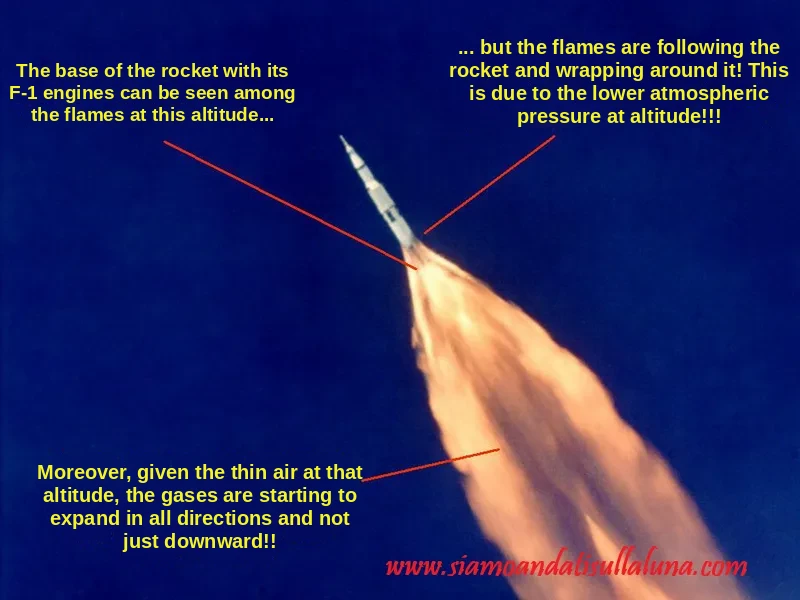
A classic example , one anyone can check, that helps visualize this inescapable fluid-dynamic principle of gas expansion in a vacuum is the appearance of the exhaust plume of the Saturn V first stage. When the gigantic rocket lifted off the pad, the column of exhaust gas released by the 5 huge F-1 engines was kept narrow, focused and devastating precisely thanks to the strong atmospheric confinement provided by the pressure of the surrounding air at sea level. As the altitude increased, however, the pressure of the surrounding air dropped drastically and the exhaust plume began to look more and more like a broad fan. Approaching orbit, this unconstrained expansion became so extreme that it turned the gases into a gigantic, belching fireball that, seen from the ground, almost seemed to be consuming and swallowing the rocket itself. Precisely in order to survive the catastrophic backflow of heat caused by this monstrous scorching expansion of low-pressure gas, the first-stage engines were meticulously wrapped in thick, fireproof thermal blankets, while the entire base of the second stage was heavily armored with a dedicated heat shield, essential to withstand the heat generated by the five cryogenic J-2 engines firing in a vacuum. If physics forces a leviathan like the Saturn V to disperse its thrust in this way as atmospheric pressure falls, it is obvious that the tiny, throttled-down DPS engine of the LM could in no way maintain, with all due respect to the Moon-hoax theses, a cohesive, cutting flame capable of digging a hole in the hard lunar rock.



Everything said so far can therefore be summarized in a handy concluding slide...
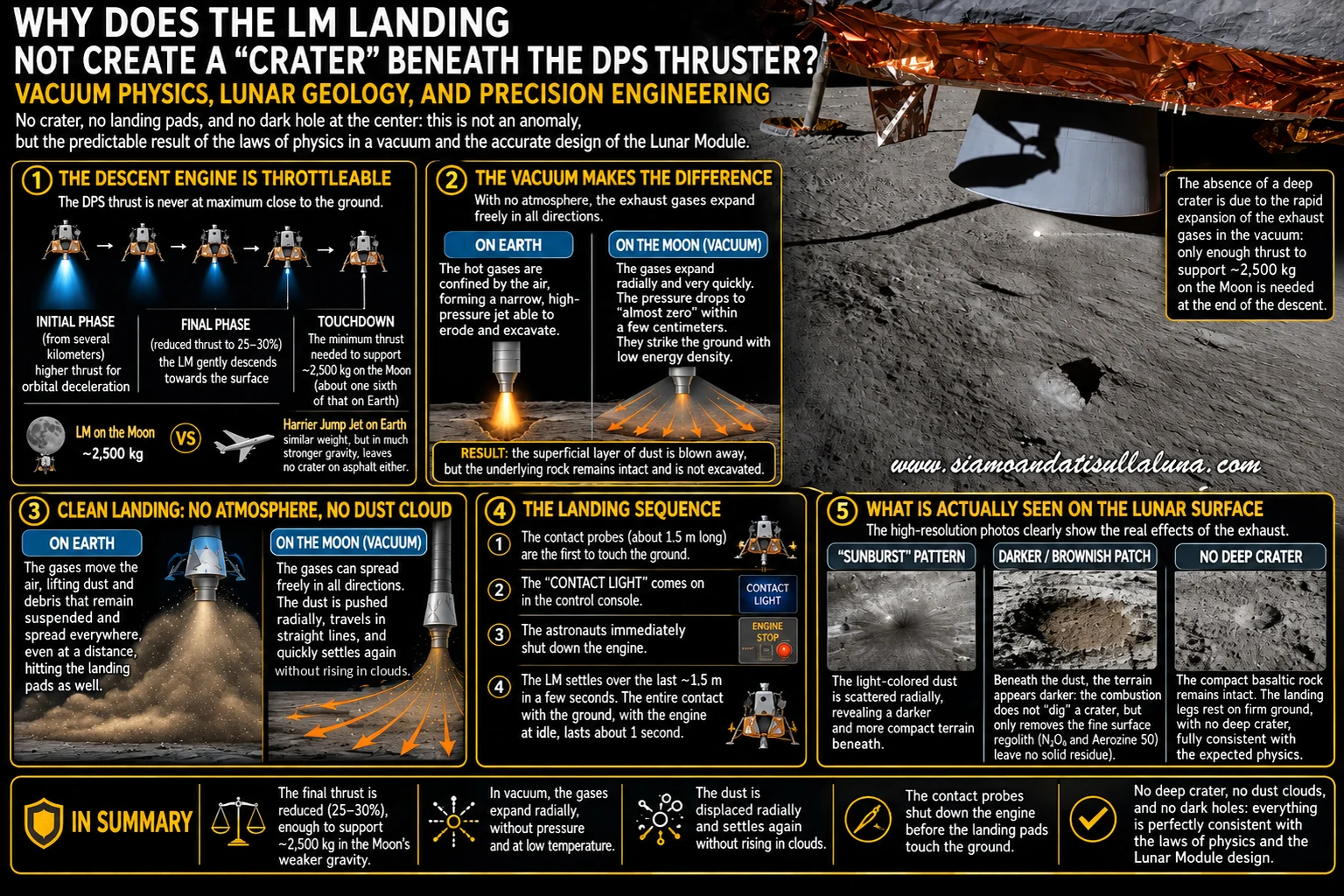
In conclusion, the absence of a deep crater does not mean that the ground was left untouched at all! If you look at the high-resolution photos taken by the astronauts walking around the LM (photos that conspiracy theorists carefully avoid showing in full), you will see an obvious, spectacular "sunburst" pattern: the surface layer of light-colored dust has been swept away radially, exposing the darker, more compact ground below. In addition, the area directly under the nozzle often looks brownish or blackened. This is because the engine used hypergolic propellants (nitrogen tetroxide and Aerozine 50), whose highly reactive combustion chemically "burned" the soil and stained it with brown nitrogen oxides. Everything, from the lack of a deep excavation to the clean footpads and the chemical stains on the ground, fits perfectly and unforgivingly with the inflexible laws of nature, turning yet another alleged conspiracy anomaly into a magnificent lesson in aerospace engineering and vacuum physics.