The story of the Lunar Module made of tinfoil...

The claim that the Lunar Module was built with "tinfoil and duct tape" is perhaps one of the most iconic, and most embarrassing, examples of technical ignorance spread far and wide by supporters of the Moon hoax theory. Looking at the photographs taken by the astronauts on the lunar surface, deniers point to the clumsy, crumpled, multicolored and seemingly fragile exterior of the lander, concluding with extreme superficiality that such a "shack" could never have survived a space journey. Let alone a Moon landing and days on the lunar surface, where the temperature swings between day and night are truly extreme ...
This claim, like all the others, completely ignores the complex materials engineering and the unique physical conditions of the lunar environment, mistaking a sophisticated heat shield for a prop wrapper, good, in their view, only for fooling the usual crowd of gullible people ... To understand the facts, however, keeping a proper distance from the usual worn-out, crude barroom chatter (because, data in hand, that is all it is), we need to look further and analyze in context the external appearance of the Lunar Module, which was not covered with tinfoil and duct tape, but with a genuine "space protective blanket", still used today, by the way, by every space agency and aerospace company in the world...
The Lunar Module was an extraordinary machine, designed to be light and strong at the same time. Under the outer coverings there was not nothing, but an extremely solid structural shell called the "Ascent and Descent Stage Structure", made of aircraft-grade aluminum alloys (mainly 2219 and 7075-T6 aluminum). This structure also contained the real cockpit where the astronauts lived: a rigid shell, precision-machined, designed to maintain an internal pressure of about 5 PSI (0.34 bar) of pure oxygen without deforming. The LM was, to all intents and purposes, a multi-role vehicle designed to operate exclusively in the vacuum of space!
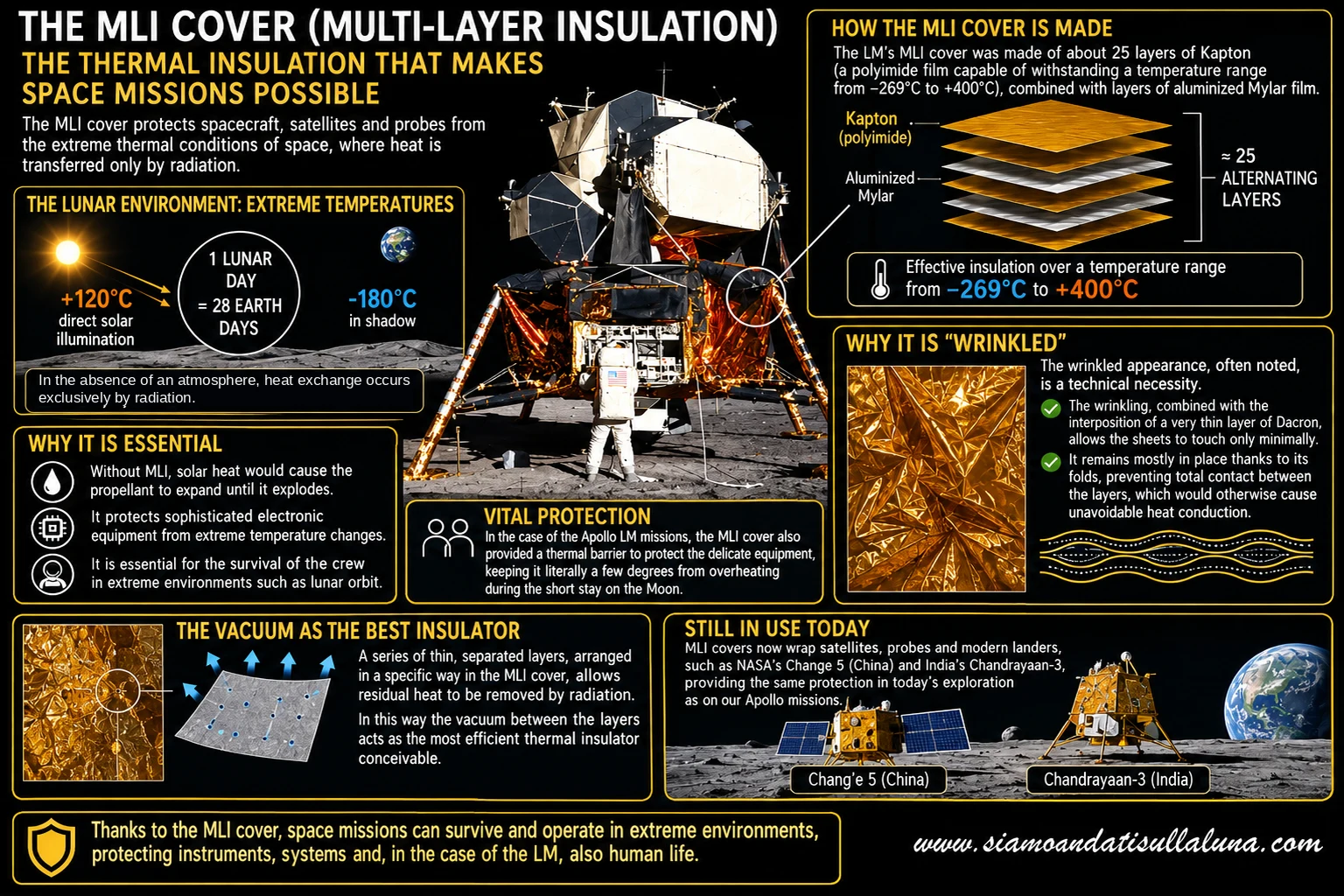
So why did it look so "fragile"? The answer is that the LM did not have to fly in Earth's atmosphere. On Earth, an aircraft has to be aerodynamic and have a "thick metal skin" to cope with the resistance of the air. In space, aerodynamics is irrelevant! The LM, in fact, was released from its protective shell called the SLA only once the whole stack had reached deep space and was surrounded by the deadly vacuum of space. During design, every gram saved on the external unpressurized structure was one more gram of propellant for the launch vehicle or the lunar spacecraft, and invariably of lunar samples that could be brought back to Earth. As a result, the outer panels of the lander that were not meant to contain pressure were made of very thin aluminum sheets (in some places only 0.3 mm thick), since their only purpose was not structural, but simply protective. What conspiracy theorists, puffed up like turkeys with their careless arrogance, disparagingly call "tinfoil" is actually MLI (Multi-Layer Insulation), a sophisticated multilayer insulation, the forerunner of today's insulation systems used on the artificial satellites launched into orbit every day and on the interplanetary probes still studying other worlds today.
 Detail of the layers of a modern MLI used on commercial communication satellites.
 Many people don't know that hiking emergency blankets are made of the same Mylar used in aerospace MLI...The LM's MLI blanket (Multi-Layer Insulation) consisted of about 25 layers of Kapton sheets (a polyimide able to insulate across a temperature range from -269°C to +400°C), joined and interleaved with aluminized Mylar films. It is well known that on the Moon, with no atmosphere, heat is exchanged only by radiation; for this reason, at certain times of the lunar day (which lasts about 28 Earth days), temperatures can range from +120°C in direct sunlight to -180°C in the shade. Without these "crumpled blankets" covering the Lunar Module (and still covering today, although conspiracy theorists don't know it, the Chinese and Indian probes sent to our satellite), solar heat would make the propellant tanks expand until they exploded and would damage the sophisticated equipment needed to operate in a hostile environment like the lunar surface. In the specific case of the Apollo LM, the MLI covering also had the vital task of protecting the precious human crew inside, literally preventing the astronauts from roasting in the Sun during their short stay. The crumpled look that so agitates conspiracy theorists, moreover, was and still is an essential technical requirement. This crumpling, together with the insertion of a fine Dacron mesh, means that the sheets making up the thermal blanket touch each other only minimally. Kept mostly apart by their own creases, they avoid a full physical contact that would inevitably trigger heat transfer by conduction. A special series of tiny vent holes, placed in strategic positions on the MLI blanket, also allowed the residual air trapped during launch from Earth to escape, letting the vacuum of space penetrate between the layers and act as the most efficient thermal insulator ever conceived. As you can see, knowing physics literally saves lives: you just have to understand its laws and apply them as well as possible, with all due respect to the conspiracy theorists...


At this point we also need to bust another myth! It is true that on the Moon there are monstrous temperature swings that can range from +120°C at lunar noon to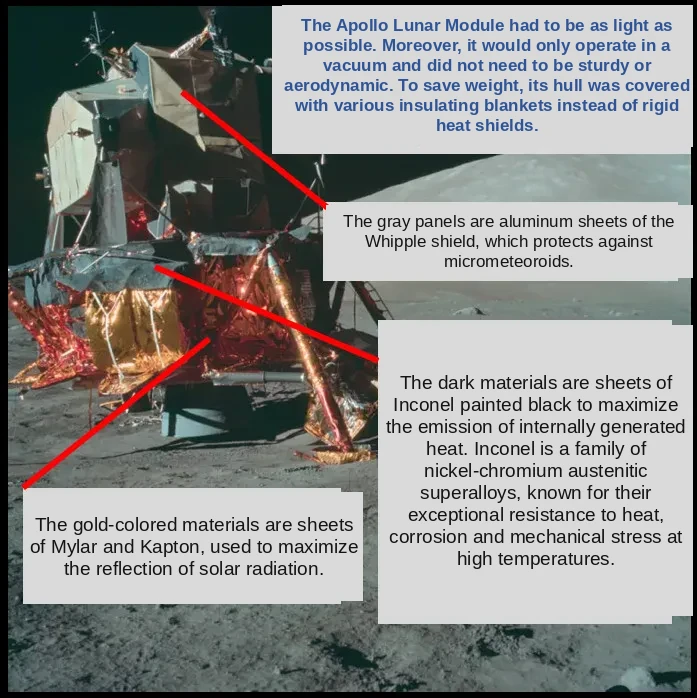 -173°C at lunar midnight, but these are not present at all latitudes, nor do they spread very quickly. As explained earlier, in fact, in the vacuum of space and on the airless lunar surface, the only way heat can be transferred is by simple radiation, which is the least efficient of the three ways possible in nature under the laws of thermodynamics. The other two are: conduction (contact between objects) and convection (possible only if there is an atmosphere to carry it). When the astronauts landed on the Moon, they always did so when at the chosen site it was early morning. See for yourself in all the photos of the Apollo missions: the Sun is always very low on the horizon! NASA knew that to have suitable landing conditions, it was essential to aim for a lunar area that was at that moment near the terminator, the line dividing day from night that twice a month makes the Moon look like a larger or smaller crescent in the sky. In those particular areas the lunar ground was emerging from the cold of the night and slowly (remember that a lunar day lasts 28 Earth days) began to warm up, mainly through solar radiation. When the LM's legs settled into the lunar regolith, its average temperature in sunlight was only +15°C , allowing the astronauts, sealed in their white suits (a color certainly not chosen at random), to move about on the Moon cooled simply by the small evaporators in their PLSS backpacks. At this point it is easy to see how the LM's MLI covering was more than enough to provide an effective protective shield against the rising temperatures over the maximum of three days planned for exploration. When the LM left the lunar surface, the temperature had risen considerably, as had the Sun's height above the horizon, reaching as much as +90°C. Staying on could have been dangerous without an effective passive thermal control maneuver! That is precisely why there were launch windows for the Apollo missions. Delaying the departure meant reaching the chosen lunar site with a much higher Sun, which, besides making the landing maneuver more difficult (shadows were essential for spotting craters and boulders during touchdown), would have created harsher local thermal conditions, which could have severely tested the protective structures of the intrepid lunar spacecraft.
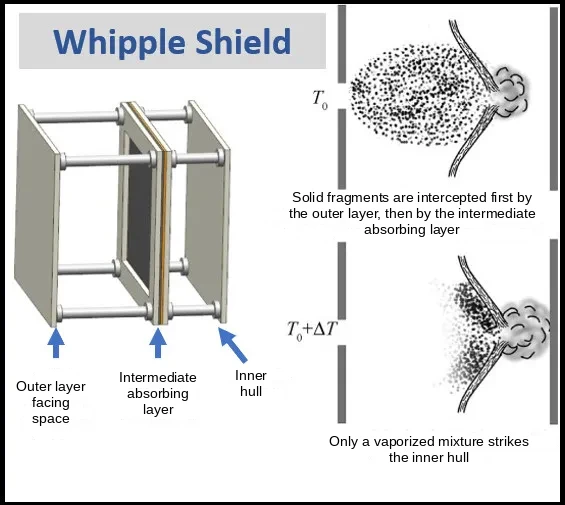 It should also be said that the outer MLI covering also acted as a shield against micrometeoroids. In deep space and on the lunar surface, in fact, the risk of running into small fragments of space rock in free fall is very high; these travel through the vacuum at such speeds that they pose a serious threat to the structural integrity of human-made objects, striking them at speeds of up to 70 km/s. To put it simply, these are the same rock fragments responsible for the beautiful show of "shooting stars" on Earth. Traveling at extremely high speeds, these bodies enter Earth's atmosphere, inexorably disintegrating and leaving the classic, romantic streak of light. In space, however, where there is no atmosphere, these bodies hit objects with incredible energy , causing devastating damage if they are not properly stopped. To put it simply, if a micrometeoroid the size of a pebble were to hit the bulkhead of a spacecraft that was not properly protected, it would do so with the same energy as a bowling ball traveling at 70 km/h! The MLI covering therefore acted as a Whipple shield: the impact with the first sheet of Kapton vaporized the tiny projectile, turning it into a harmless cloud of plasma that was then finally stopped by the inner aluminum armor below, having lost on the first impact most of its incoming energy. These materials and physical principles were the basis of modern bulletproof vests and helmets, since Kapton and Dacron are direct ancestors of today's Kevlar and of the protective systems used today, including on the International Space Station. The adhesive tape visible in the Apollo photos of the LM, on the other hand, was nothing other than the famous amber Kapton tape, essential for sealing thermal joints. It performed so well that it is still the standard of the global aerospace industry today.
The LM was therefore a masterpiece of efficiency: a solid aluminum armor inside to protect life, wrapped in a very light suit, almost impenetrable to micrometeoroids and highly reflective on the outside to best manage the incoming solar energy during the few days spent on the Moon. Calling it a "tinfoil construction" only shows how easy it is to go wrong when you try to judge a machine designed for space, perhaps using your own meager knowledge of the subject.
A wonderful video made by our friends at Apollo11Space that explains in detail why the Lunar Module looked fragile and ungainly at first sight. Audio is also available in Italian. To turn it on, click "Settings" (gear icon) -> "Audio Track" -> "Italian".
The Lunar Module was not beautiful, but it was the perfect machine for the Moon, however ungainly it looked as a whole. It is no coincidence that it has been copied many times by anyone who wanted to land and stay for a while in that extreme environment. Look, for example, at the exterior of the Chinese Chang'e probe, which also has four legs, black Kevlar anti-meteoroid panels and the iconic crumpled gold MLI covering. On that point, I have yet to hear a single conspiracy theorist comment. Physics stays the same even as the ages go by and technology advances!