The myth of Stanley Kubrick as director...
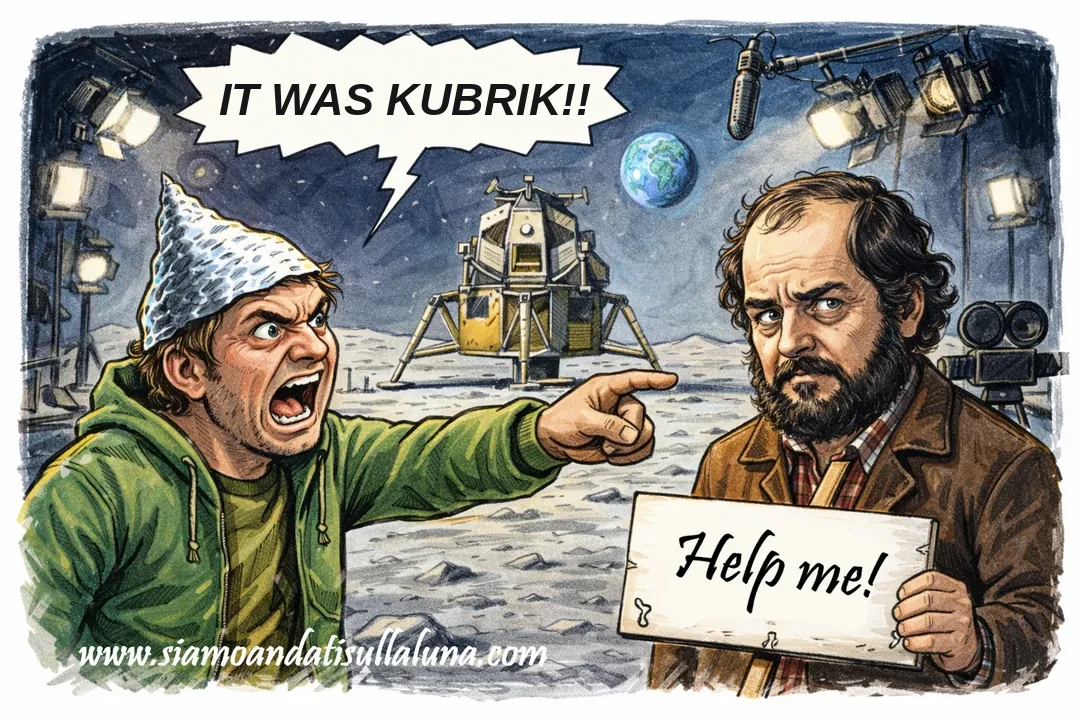 To fully understand the origin of one of the most deeply rooted urban legends of modern history, we need to look at the monumental figure of Stanley Kubrick and at the reason why conspiracy theorists have chosen him as the alleged mastermind of the space deception. Kubrick is universally recognized as one of the most brilliant, visionary and influential masters of the seventh art, famous for his obsessive perfectionism and absolute control over every technical, photographic and narrative detail of his sets. The spark that set off the denialist imagination lies in an extraordinary coincidence of timing combined with an unprecedented leap forward in special effects. Less than a year before Apollo 11 left its launch pad in Florida, Kubrick had spellbound the whole world by bringing to the big screen a depiction of the cosmos, of orbital dynamics and of lunar landscapes with a visual realism that was simply unimaginable at the time. In the
 eyes of those who see conspiracies everywhere, the equation seemed all too obvious: if a director had managed to simulate the extraterrestrial environment so dramatically convincingly for the cinema, the American space agency, desperate and pressed by the urgency of winning the Space Race, must inevitably have hired him to stage a televised victory over the Soviet Union. Of all the countless, fanciful constructions of Moon-landing denial, none has gripped the collective imagination as much as the urban legend that would put the famous director Stanley Kubrick behind the camera of the greatest hoax in history. According to this story, NASA, stunned by the visual realism of the masterpiece "2001: A Space Odyssey", released in 1968, secretly hired the filmmaker to shoot in a film studio the Apollo 11 landing sequences. The most die-hard conspiracy theorists even go as far as dissecting another famous Kubrick film, 1980's "The Shining", interpreting it as a very long, tormented coded confession: little Danny wearing an Apollo 11 rocket sweater, the infamous change of the number of the cursed room from 217 (as in Stephen King's novel) to 237 (which conspiracy theorists crudely associate with the average distance in miles between the Earth and the Moon, ignoring that the real distance is about 238,855 miles), and other alleged esoteric symbols. This fascinating pop fable, however intriguing if read as a work of fiction, crashes disastrously as soon as it is put through the relentless scrutiny of film history and of the insurmountable limits of 1969 optical and television technology. To
 understand the technical impossibility of faking the Apollo 11 broadcasts, it is essential to look at the tools actually available to filmmakers at the time. In 1969, computer graphics (CGI) simply did not exist! To create the magnificent alien landscapes of "2001: A Space Odyssey", Kubrick had to make massive, pioneering use of analog effects such as "front projection" (front projection). This complex technique consisted of projecting a background image onto a gigantic, highly reflective screen behind the actors, using a half-silvered mirror placed at 45 degrees in front of the lens of the camera. If NASA had used this trick to simulate the desolate lunar horizon, the huge amounts of dust kicked up by the astronauts' falls or, on later missions, by the Rover's wheels would inevitably have crossed the projector's directional beam, grotesquely giving the trick away and casting the crew's shadows directly onto the fake printed backdrop. In the Apollo footage, on the contrary, the explorers move seamlessly through 360 degrees in a boundless three-dimensional environment, physically interacting with the terrain in depth of field without the horizon betraying the slightest two-dimensional flatness. Another insurmountable obstacle, which no photographic genius could ever have got around on a set on Earth, concerns the physics of lighting. On the Moon there is only one, very distant and very powerful light source: the Sun. Since our star is 150 million kilometers away, its rays reach the lunar surface parallel to each other. This means that an object lit on the Moon will keep
 the very same light intensity whether it is two meters or two kilometers from the lens. If Kubrick had had to shoot the scene on a gigantic sound stage for NASA, to simulate the Sun and obtain single, sharp shadows he would have had to use a monstrously powerful artificial spotlight placed relatively close by. This is where a merciless rule of optical physics comes into play: the inverse-square law (1/r²). According to this mathematical principle, the intensity of light from an artificial source falls off very quickly as you move away from it. In a studio on Earth, an astronaut walking away from the spotlight toward the back of the set would appear progressively and inexorably darker, and the surrounding ground would quickly lose light and fade into darkness. In the films and thousands of photographs of Apollo, the light is instead dazzling, constant and uniform from the tips of the boots in the foreground all the way to the mountains on the horizon, unequivocally proving that the source of that radiation was not hanging from the ceiling of a secret studio, but sitting at the center of our solar system! But the definitive, fatal proof that burns the occult-director theory to ashes lies in the recording medium and the uninterrupted length of the broadcasts. Neil Armstrong and Buzz Aldrin's first moonwalk was a continuous, uninterrupted live television broadcast, lasting more than two and a half hours. Conspiracy theorists invariably claim that, to simulate the
 low gravity, the actors were filmed on Earth and the film was then played back in slow motion (slow motion). However, in 1969, 35mm or 70mm film reels had an extremely limited physical and mechanical capacity: a standard movie camera magazine could hold at most about ten or fifteen minutes of footage before the film ran out, forcing the operator to stop the action to reload the camera. Recording two and a half hours of uninterrupted action in slow motion, without a single edit or transitional blur, was materially and mechanically impossible with the cameras of the time. If, on the other hand, deniers suggest that studio TV cameras were used (which recorded on huge magnetic tapes), the problem becomes just as insurmountable: the professional video recorders of 1969 did not have the circuitry and electronic memory needed to store hours of tape and instantly play it back at a perfectly slowed, smooth and continuous rate without showing disastrous visual artifacts, flicker or image tearing. Moreover, the Westinghouse lunar camera used on Apollo 11 transmitted in a proprietary slow-scan format (SSTV) at a meager 10 frames per second, specially engineered to survive the extremely narrow bandwidth of interplanetary communications. Secretly converting, by analog means, a standard terrestrial video signal into a slowed-down SSTV format, without interruption and live to the whole world for hours, was far beyond the capabilities of all the world's television engineering at the time. Paradoxically, in 1969 we had the ballistic technology to send two men to the Moon, but not the electronic technology to fake the live broadcast. Finally, there is a paradoxical character trait that anyone who knows the biography of the real Kubrick simply cannot ignore: his legendary, proverbial, obsessive pursuit of aesthetic perfection. The director imposed on his actors and crew dozens, sometimes hundreds of exhausting takes to get a single perfect shot, handling lighting, shot geometry and acting in a clinical, obsessive way. The original Apollo footage, on the contrary, is the raw antithesis of auteur film grammar. It is grainy, shaky, full of crooked framing, merciless sun flares that blind the lens (and sometimes damage it irreversibly, as in the case of Apollo 12), astronauts stumbling and floundering in the dust, in a riot of operational mishaps and rough documentary realism. If Stanley Kubrick had really directed the Moon landing with an unlimited budget, he would never have tolerated a cameraman accidentally pointing the camera at the Sun and burning out its phosphors, nor would he have allowed the nation's heroes to struggle for minutes, live to the whole world, to plant a pole in the ground. Ironically, the brutal visual imperfection of that historic footage is the inimitable signature and supreme seal of its courageous authenticity.