The story of the deafening noise during the mission...

One of the most frequent criticisms from conspiracy theorists concerns the absence of engine roar in the audio recordings of the Apollo missions. According to this thesis, the roar of a rocket engine should have completely drowned out the astronauts' voices, making communication impossible. This objection, however, ignores the basic principles of acoustic physics and  aerospace communications engineering, starting from the mistaken assumption that sound can behave in a vacuum as it does in Earth's atmosphere.
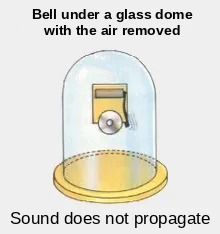
 Understanding why the recordings sound silent requires a rigorous analysis of the physics of sound, which is a longitudinal mechanical disturbance that can only propagate through an elastic medium, whether gas, liquid or solid. On Earth, we are used to hearing the roar of an engine because the atmosphere acts as a conductor: air molecules are compressed and rarefied by the kinetic energy of the exhaust gases, transmitting the shock wave all the way to the human eardrum or to the membrane of a microphone. In deep space and on the Moon, the molecular density is practically zero, making the formation of airborne sound waves physically impossible. The Lunar Module's descent engine (DPS) and ascent engine (APS), while generating powerful thrust through the hypergolic combustion of Aerozine 50 and nitrogen tetroxide, expel their gases into a vacuum that offers no molecular resistance. With no atmosphere to "vibrate", the deafening roar we associate with launches on Earth simply does not exist outside the vehicle. The exhaust gases instantly expand into an invisible, silent fan-shaped plume, since the kinetic energy of combustion is converted entirely into directed thrust without being dissipated as ambient sound waves. This total absence of a gaseous medium made it impossible not only to hear the engines, but even for the astronauts to talk to each other directly once out on the lunar surface. Without a VHF radio system (Very High Frequency), two astronauts could not have communicated even when talking ten centimeters apart, because the sound waves produced by their vocal cords would have remained confined inside the pressurized helmet, unable to cross the vacuum

 outside to reach their crewmate. Every word exchanged during extravehicular activities (EVA) was picked up by a microphone, necessarily passed through the intercom and transceiver electronics of the suits, turned into a radio signal and was then converted back into sound inside the other helmet by the same circuits and the earpieces of the headset. A failure of the suit radios would have completely cut off the astronaut from communicating both with his crewmate on the surface and with Mission Control in Houston. The astronauts had a way of signaling that they could not communicate by radio: rotating a hand next to their ear. Their crewmate would understand the problem and take the appropriate countermeasures. As for the RCS maneuvering thrusters, the Service Module's SPS engine or the mighty J-2 of the Saturn V third stage, their silence in the radio communications is not a cinematic omission but a requirement of thermodynamics. Inside the pressurized cabin, the astronauts could feel a dull "clack" or a structural vibration caused by solid conduction through the spacecraft's metal hull, but that sound remained confined within the structure and could in no way be picked up by the onboard microphones with the intensity of a roar. This is because space rocket engines do not operate in intermittent explosion cycles like the pistons of a car, but with continuous, laminar flow, drastically reducing low-frequency sound harmonics. Moreover, the descent engine was mounted on the lower stage of the LM, physically separated from the crew cabin by layers of thermal insulation and mechanical mounts designed to damp loads and vibrations, effectively acting as a passive acoustic filter that prevented the transmission of the high frequencies produced by the combustion chamber. We must also never forget that the LM consisted of two independent spacecraft joined by explosive separation bolts: the descent stage and the ascent stage.
 Snoopy CapBetween the two there were a few centimeters of free space, which, when the spacecraft was in space, were filled by absolute vacuum. No noise, therefore, apart from a faint hum carried through the structure, could reach the astronauts, who felt the chemical braking of the engine only through the accelerations imposed on the hull, which each time interrupted the pleasant feeling of weightlessness. A decisive role in the cleanliness of the audio tracks is played by telecommunications engineering and the design of the radio transmitters. Communications between the Moon and Houston used an S-band system that relied on signal processing technology that was extremely sophisticated for
 Communication on the lunar surface was only possible thanks to the VHF transceivers in the PLSS backpacks of the spacesuits. Because of the vacuum of space, any spoken communication would otherwise have been impossible. the time. One of the key elements was the squelch circuit, an automatic muting function designed to suppress white noise and background interference when there was no active voice signal. The squelch acted as a logic gate: only when the sound pressure detected by the microphone exceeded a certain decibel threshold did the transmission channel open. This prevented the constant hum of the oxygen recirculation fans, the cooling pumps or residual engine vibration from being transmitted to Earth, which would have made the important air-to-ground communications difficult, noisy or, worse, unintelligible, and it created that effect of total silence between the astronauts' sentences. Completing this acoustic isolation was the configuration of the microphones worn by the crews inside the so-called "Snoopy Cap". These were noise-canceling dynamic microphones, mounted on flexible booms that positioned the pickup capsule just a few millimeters from the pilot's lips. This extreme closeness was no accident: being pressure-gradient microphones, they exploited the proximity effect to emphasize the human voice over any ambient sound. A noise coming from the back of the cabin, or carried through the air inside the helmet, would hit both sides of the microphone membrane almost simultaneously, canceling itself out through destructive interference. The astronaut's voice, on the other hand, being produced at close range, hit only one side of the membrane with dominant intensity, ensuring that only speech was converted into an electrical signal. So the conspiracy idea that engine noise should have drowned out the astronauts' voices is technically wrong: even if the engine had been audible inside the cabin, the directional microphone technology and the tuning of the radio system would still have isolated the voice communication, making the surroundings electronically mute. Besides noise management, another pillar of the technical truth is the constant presence of a communication delay, a phenomenon imposed by the speed of light. The Moon is on average about 384,400 km from Earth; since radio signals travel at about 300,000 km/s, each message takes about 1.28 seconds to cover the distance one way. In a dialogue between Mission Control in Houston and the astronauts, this means a minimum delay of over 2.6 seconds to receive an answer. In the original recordings, this gap is systematically present and matches exactly the deterministic calculations of the spacecraft's position. If the missions had been filmed in a studio on Earth, actors and directors would have instinctively followed the rhythm of a natural conversation or would have struggled to simulate this constant, nerve-racking latency with mathematical precision for the entire duration of the missions. The presence of this delay, together with the "cleanliness" of the voice signal, is not an editing flaw, but the acoustic signature of deep space!
Ultimately, expecting to hear the roar of engines in the lunar recordings means projecting our Earth-bound expectations onto an environment that obeys diametrically opposite physical laws. The "silence" of the engines is therefore not a sign of forgery, but the definitive proof that the astronauts were really immersed in the vacuum of space. If NASA had wanted to stage the missions in a television studio, it would paradoxically have added exactly the dramatic sound effects the public expected to hear; the absence of such noises instead confirms that technical reality prevailed over the narrative fiction desired by our Moon-hoax friends, once again refuting the theses of those who confuse the laws of physics with the clichés of science fiction films.