The authenticity of the Apollo radio signals and photographic evidence from Earth...
 Conspiracy theorists, in their effort to defend the indefensible, often go as far as claiming that the historic radio communications between the Apollo astronauts and Mission Control were nothing but audio recordings made in a comfortable studio on Earth, or at most transmissions cunningly bounced off some secret satellite in low Earth orbit. This yet another desperate hypothesis crashes into an insurmountable wall: the physics of radio waves and the inherently public and traceable nature of space telecommunications. Electromagnetic waves do not recognize political borders and cannot be hidden or confined within a government script. Anyone with a sufficiently powerful and directional antenna, together with a receiver tuned to the right frequency, can not only listen to a space signal but, even more importantly, determine its point of origin in space with absolute geometric precision. And that is exactly what happened in July 1969 and throughout all the following missions. NASA was not the only organization with its antennas pointed at the sky! While the whole world watched the official live broadcast, a dense network of radio astronomy observatories completely independent of the US government was tracking and intercepting the Apollo spacecraft on its own. The legendary Jodrell Bank radio telescope in Great Britain, led by Sir Bernard Lovell, pointed its colossal 76-meter dish straight at the Moon, picking up the signals of the Command Module and the Lunar Module. The same was done by the Bochum observatory in West Germany, under the direction of Heinz Kaminski, which intercepted and recorded the astronauts' voices completely independently of Houston's Mission Control. If the signal had come from a secret base in the Nevada desert or from a satellite in low Earth orbit (a few hundred kilometers up), these huge international dishes would have found it impossible to chase across the sky an object streaking from one side of the horizon to the other in a few minutes. Instead, to catch those historic words, all the antennas in the world had to point steadily at a single, unmistakable target in the cosmos, following its slow, relentless apparent motion across the night sky: the Moon, 384,000 kilometers away. To this glaring geometric confirmation we must add the unimpeachable scrutiny of the rival superpower. As we have already noted, the Soviet Union had a first-class space program and an absolute interest in spying on every single move of the capitalist enemy. The Soviets used their deep-space listening complexes, such as the large radio astronomy center at Yevpatoria in Crimea, to intercept the telemetry, the voice communications and even the raw television signal sent by the Americans. The technicians of the KGB and the Russian scientists had extremely sophisticated direction-finding and triangulation equipment. If NASA had tried to simulate the communications , pretending that they came from deep space, the Soviets would have detected the directional discrepancy of the signal in a fraction of a second, exposing the farce and inflicting on the United States the most devastating political and diplomatic humiliation in modern history. The fact that the USSR instead confirmed the Moon landing and congratulated the Americans certifies that its military instruments had unequivocally traced those radio signals to the surface of the Sea of Tranquility. But the authenticity of those communications is branded by an even more
 Houston's Mission Control Center (MCC) was the nerve center of Apollo Program flight operations. Photo courtesy of NASA. refined physical phenomenon that is impossible to fake: the Doppler effect. When a spacecraft orbiting the Moon moves toward the Earth (in the visible part of its circular orbit), the radio waves it emits are "squeezed", undergoing a measurable increase in frequency. Conversely, when the spacecraft moves away to disappear behind the far side of the satellite, the waves are "stretched", lowering the frequency picked up by receivers on Earth, until the signal cuts off abruptly (occultation), because the rocky mass of the Moon physically gets in the way between the spacecraft and the Earth. Independent observers all over the world, recording the Apollo signal, measured this constant Doppler shift with millimeter precision. The frequency signature recorded described mathematically and incontrovertibly the orbital position, the speed and any accelerations and decelerations , as well as the occultation of a vehicle orbiting exactly around the gravitational mass of the Moon. No computer or analog simulator of the time could have generated and faked in real time such a complex Doppler shift , consistent and interceptable by any independent scientist listening on the planet. Often, however, conspiracy theorists, cornered by the mathematical elegance of the global Doppler measurements, attempt one last, desperate narrative countermove. They claim that NASA could have secretly launched an uncrewed robotic probe into lunar orbit, a sort of "dummy spacecraft", equipped with a powerful transmitter and a pre-recorded magnetic tape with fake crew voices, telemetry data and background noise. Silently orbiting the Moon, this probe would have fooled the independent radio telescopes and the Soviets, producing a genuine Doppler shift and perfectly simulating the occultations behind the lunar mass.
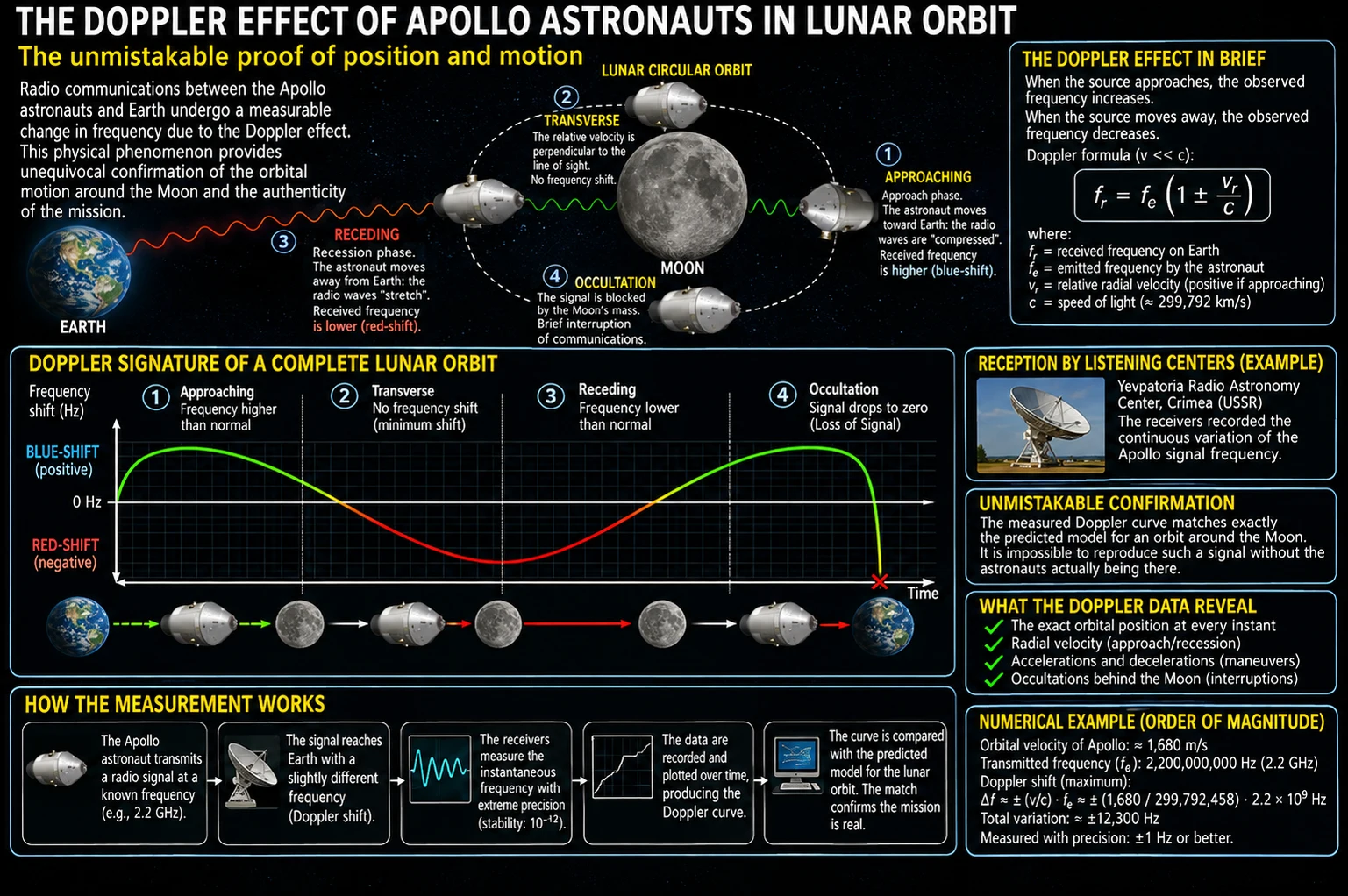
This hypothesis, however Machiavellian, crashes disastrously into an insurmountable physical and kinematic obstacle: the transmissions of the astronauts who landed on the lunar surface! When the Lunar Module of each mission separated from the Command Module to then land on the Moon, the electromagnetic picture received on Earth changed drastically. As we know from the laws of celestial mechanics, the Moon is in synchronous rotation with our planet, which means that it takes the same time to rotate on its axis as it does to orbit the Earth, always showing us the same face. As a result, a transmitter placed and physically anchored on the near side of the lunar surface never disappears behind the lunar horizon. While the Command Module kept orbiting alone, undergoing periodic Doppler shifts and predictable signal interruptions (LOS - Loss of  The brothers Achille and Giovanni Battista Judica-Cordiglia. In the 1960s and '70s they became famous for the very Italian ingenuity with which they built a radio observatory (Torre Bert) dedicated to receiving signals from space during the space race between the USA and the USSR. During the Apollo 11 mission, they picked up the radio communications between the astronauts on the Moon and Houston's MCC.Signal) and reacquisitions (AOS - Acquisition of Signal) every time it passed behind the far side of the satellite, the Lunar Module's radio signal behaved in the diametrically opposite way. The voice and television communications of the moonwalk were transmitted continuously, steadily and without interruption for hours on end, free from any occultation and, above all, with the classic latency typical of a signal coming from deep space, that is, from 384,000 km away (2.6 seconds on average between a question and an answer). Moreover, being literally parked on extraterrestrial rock, the LM's transmitter instantly lost the sudden, marked frequency shifts typical of a vehicle in orbit racing along at 1.6 km/s (5,800 km/h). The lander's Doppler signature dropped almost to zero, showing only a microscopic variation, very slow and highly distinctive, caused solely by the rotation of the Earth on its axis, the orbital motion of the Moon and the slight wobbling motions (libration) of the satellite. No single "dummy probe" in orbit could ever have split itself electronically in two, transmitting at the same time and on the same carrier frequency a dynamic orbital signal (with strong Doppler and cycles of silence) and a static surface signal (continuous, with residual Doppler). If deniers, desperate to save their theory, suggested sending a second dummy probe that landed automatically to broadcast the recorded tapes from the surface, they would run into an obstacle that is even more grotesque and ridiculous: real-time interaction! The communications between Houston's Mission Control Center and the astronauts on the lunar surface were not a pre-set monologue, but a live dialogue, interactive and full of unpredictable variables, subject to the inevitable physical delay of about 2.6 seconds due to the round-trip time of radio signals traveling at the speed of light through the vacuum of space. A 1969 analog tape recorder, locked inside an automatic orbiter or lander, had no way of listening to an unpredictable question from Mission Control in Houston, analyzing it and "searching" the tape for the exact answer to play it back with the right
 Larry Baysinger, a technician at radio station WHAS in Louisville, Kentucky, independently detected and recorded the Apollo 11 radio transmissions between the astronauts on the lunar surface and the command module. timing. In 1969 that technology really was science fiction! And it would remain so at least until the first decade of the 2000s. Moreover, Houston's Mission Control Center was not a film set filled with extras dutifully reading a script, but a hyper-complex, dynamic ecosystem constantly in the spotlight of the world's press, in which dozens of engineers, technicians, scientists, doctors and flight directors reacted in real time to real telemetry data streams, unexpected and constantly changing. It would have been humanly and theatrically impossible to coordinate this huge control room so as to handle, without the tiniest slip for hours and days on end, highly technical discussions, synchronizing them perfectly with what was being broadcast continuously by a blind mechanical player out in space. Those explorations were full of events that could not be planned in advance: labored breathing that prompted a medical question, an unexpected onboard computer alarm, a cryogenic tank that was acting up, one side of the hull overheating in the Sun while the other was freezing in the shade, a rock slipping out of a hand, or an impromptu request for geological clarification. The slightest timing error by the CAPCOM, a single omission, or a split second of hesitation in giving an answer would inevitably have overlapped with the next pressing question pre-recorded on the space tape. This lack of synchronization would have caused an embarrassing, grotesque and inevitable breakdown in the sequential logic of human communication, instantly exposing the whole fraud live to the world , in front of thousands of people, politicians, scientists, journalists and radio amateurs listening all over the planet. Independent observers around the world, and Soviet intelligence first and foremost, instead clearly tracked two distinct radio sources, consistent and physically separated in cislunar space: one orbiting and subject to occultation and Doppler and another relentlessly fixed on the lunar regolith, from which came a human conversation delayed by about 2.6 seconds. This simultaneous double kinematic tracking is the definitive mathematical proof that the hardware, and the men inside it, were exactly where history has always said they were: on the Moon! Closing the circle of evidence once and for all is the enthusiasm and ingenuity of private radio amateurs. You did not necessarily need giant radio telescopes to intercept Apollo. Several civilian radio amateurs, with excellent knowledge of electronics and home-built directional antennas, managed to pick up the VHF frequencies used by the astronauts to communicate with each other and with the Lunar Module during their walks on the surface. A famous case is that of Larry Baysinger, a Kentucky radio amateur who, in 1969, pointed a large amateur dish antenna at the Moon and successfully recorded fragments of Armstrong and Aldrin's conversations. In Italy, an equally
 During the Apollo 13 space accident, the Chabot Observatory (California) was able to photograph the crippled spacecraft and the cloud of oxygen escaping from its exploded tank. Photo courtesy of NASA.exceptional and historically documented contribution came from the brothers Achille and Giovanni Battista Judica-Cordiglia. Operating from their famous amateur listening post "Torre Bert" in the hills around Turin, these two pioneers of radio listening (already world-famous for intercepting the very first secret Soviet Sputnik and Vostok missions) pointed their antennas toward deep space. They managed to pick up and record the radio transmissions of the Apollo missions, including the memorable reading from the Book of Genesis by the crew of Apollo 8 in lunar orbit in December 1968. Here too, their recordings confirmed the perfect directional consistency and the extraterrestrial origin of the signals. The recordings of Baysinger, the Judica-Cordiglia brothers and countless other enthusiasts contained not only the voices with the same space background noise, but also showed the inescapable delay of about 2.6 seconds in the communications. Faking a radio fingerprint of this scope, complete with speed-of-light delay, orbital Doppler shifts and VHF signals that private citizens could track from their backyards, is not science fiction: it is literally a physical impossibility! The radio signal is, ultimately, the invisible yet most deafening proof that the American explorers really did break the cosmic silence of our satellite. Besides radio tracking, there is another dramatic cross-check of a purely optical nature, once again provided by astronomical observatories completely independent of the American space agency. During the ill-fated Apollo 13 mission, when the explosion of the oxygen tank crippled the Service Module more than three hundred thousand kilometers from Earth, the disaster was not only recorded by the telemetry sent to Mission Control in Houston. Several telescopes on Earth, including that of the Chabot Observatory in California, pointed their mirrors and lenses at the astronomical coordinates provided for the crippled spacecraft. What they captured on their photographic plates was not a motionless dot in low Earth orbit, but visual proof, frightening and irrefutable, of the tragedy unfolding in deep space: they managed to photograph the spacecraft as a tiny point of light surrounded by a huge, unusual spherical cloud expanding rapidly. It was the astronauts' life-giving oxygen which, escaping from the ruptured cryogenic tank, crystallized in the cold of the vacuum, reflecting sunlight. Simulating a cloud of gas expanding in a vacuum hundreds of thousands of kilometers away, and having it photographed at the same time by civilian astronomers with their telescopes, is such a grotesque idea that even the most impressionable mind should reject it. The simultaneous cross-check of telemetry data, amateur radio intercepts and independent optical confirmations locks the historical reality of the Apollo program inside a literally impregnable scientific vault!