The story of the forbidding lunar environment . . .
Conspiracy theorists claim that the astronauts could never have survived in an environment as extreme as the lunar surface. They argue that, with no atmosphere, the ground is constantly struck by unbearable temperatures and lethal radiation that would literally "roast" anyone venturing there within seconds! But let's analyze these claims one by one in detail ...

THE PROBLEM OF THE MOON'S AND DEEP SPACE'S LARGE TEMPERATURE SWINGS:
 Detail of one of the temperature probes of the "Lunar Heat Flow Experiment", installed in the lunar soil by the Apollo 17 astronauts. Photo courtesy NASA.
 Detail of one of the four wheels used on the lunar rovers of the Apollo 15, 16 and 17 missions. The mesh of zinc-coated steel piano wire is clearly visible. Photo courtesy NASA.Although these observations contain a grain of truth (especially for an organism that is not properly protected), they leave out, as usual, the basic notions of physics and NASA's careful mission planning. Much has been said about the lunar temperature, which some conspiracy theorists believe was so high it could melt the Rover's rubber tires. In making this grotesque claim, however, they overlook an obvious fact: those wheels were not made of rubber at all! They were in fact made of a sturdy mesh of zinc-coated steel piano wire, reinforced with titanium treads. This engineering design was conceived precisely because of the need to cope effectively with the peculiar lunar deserts, extremely hostile places, full of dust as abrasive as glass, stones, sharp pebbles and periodically dominated by large temperature swings. It is true that the Moon, lacking the thermal flywheel of an atmosphere, suffers the rigors of space , going from +120°C at lunar noon to -180°C at lunar midnight, but to understand why this was not a problem for the Apollo missions, we have to consider the areas and times chosen for the landings. All the lunar missions, in fact, landed near the terminator (the line dividing day from night, which often gives the Moon its typical crescent shape), precisely when it was early morning at the chosen site , with the Sun between 5° and 15° above the horizon. It has always been known that such low angles of sunlight drastically reduce the thermal energy absorbed per unit of surface! That is why there are seasons on Earth. The Apollo designers exploited the thermal inertia of the lunar regolith, which is nothing more than a more or less thick layer of dust covering the entire lunar surface. It comes from the bombardment of the ground, since the most ancient times, by micrometeorites falling freely from interplanetary space. Besides being a dangerous mix of microscopic shards that are extremely abrasive, this dust is also an excellent thermal insulator (it has a very low conductivity, about 0.0015 W/m·K in a vacuum). This means that, while the surface layer starts to warm up, the heat does not penetrate deeply and the subsoil stays icy cold, as demonstrated by a dedicated ALSEP experiment of Apollo 15, 16 and 17 (on Apollo 16 it was lost when its cable was accidentally torn out), called the Lunar Heat Flow Experiment (see the photo at top right). This instrument studied subsoil temperatures for years down to about 2.3 meters deep, showing that they stayed constant over time, even though violent temperature swings took place at the surface because of the long alternation of night and day. Since on the Moon, lacking the protective blanket of an atmosphere, there is no heat exchange by convection, the temperature rose very slowly. Thanks to this strategy, the operating temperature during extravehicular activities was perfectly manageable and, throughout the days spent there, rarely exceeded +52°C. This value was perfectly compatible with the cooling systems of the spacesuits and of the Lunar Module. The ground temperature at the time of landing was always around +15°C and the astronauts rarely reported feeling the heat of the ground or of sunlit objects through their spacesuits. Historical data on the temperatures measured on the lunar surface during the Apollo program can be found at this link.


Someone might object, however, that during the journey from the Earth to the Moon and back, the spacecraft would have been subjected round the clock to the violent thermal stresses of deep space, caused by their uninterrupted exposure to the Sun on one side and the cold of space on the other, which would have damaged them beyond repair! Here too, this is only partly true. It is true that these dangers exist in deep space, but NASA's people were no fools and knew very well how to prevent this insidious problem, solving it elegantly with a peculiar, almost choreographic maneuver: PTC, or Passive Thermal Control. Known affectionately among the astronauts as the "barbecue roll procedure" (the rotisserie chicken procedure), it involved slowly rotating the stack of spacecraft about its longitudinal axis, kept perpendicular to the Sun's rays, at a rate of 3 revolutions per hour (one revolution every 20 minutes, corresponding to about 0.3 degrees per second), thus keeping the outer surface of the spacecraft at a mild temperature between +7 and +15°C. The rotation was so slow that the astronauts could only notice it by watching the disk of the Earth or the Sun slowly slide from one window to the next, but it was vital to protect the structural integrity of the spacecraft during the long transits between the two worlds. Not only that, this controlled thermal gradient was also essential to ensure that the onboard systems of the Command and Service Module (CSM), such as the environmental control system radiators (ECS) exposed to space, the water tanks, the hypergolic propellant tanks, the cryogenic tanks, those for compressed gases such as nitrogen and helium, the fuel cells and the batteries, operated within their nominal limits. If the rotation had been stopped for too long (something constantly monitored by the EECOM controllers in Houston's MCC), tank pressures would have begun to fluctuate dangerously, forcing the crew to intervene manually with the RCS thrusters and the AGC computer to restore the precise rotation.


Many of these factors dictated the narrow launch windows of the Apollo missions, which were planned in advance down to the minute! They ensured thermal balance on the ground at the time of landing and proper visibility for the crew during the descent before landing. The latter, in fact, was just as crucial! With the Sun low on the horizon, shadows appeared much longer and much more contrasted, making craters, mountains and surface rocks easy to detect and highlighting essential parameters such as depth, height and size. All this would have been much more difficult with the Sun at the zenith, when the same obstacles would inevitably have appeared flat, hard to judge or, even worse, invisible, making the landing an easy setting for accidents , even catastrophic ones, during the delicate descent maneuvers. The A7L spacesuits were real anthropomorphic spacecraft. To handle the range of outside temperatures and, above all, the roughly 150-200 watts of metabolic heat generated by the astronaut during physical exertion, the Liquid Cooling Garment (LCG) was used: an undergarment threaded with 90 meters of PVC tubing through which chilled water flowed. The heat was then expelled outside by a porous-plate ice sublimator located in the PLSS backpack. This device exploited the lunar vacuum itself to sublimate water (direct transition from solid to gas), a process that absorbs large amounts of heat extremely efficiently.
THE PROBLEM OF MICROMETEORITE IMPACTS:
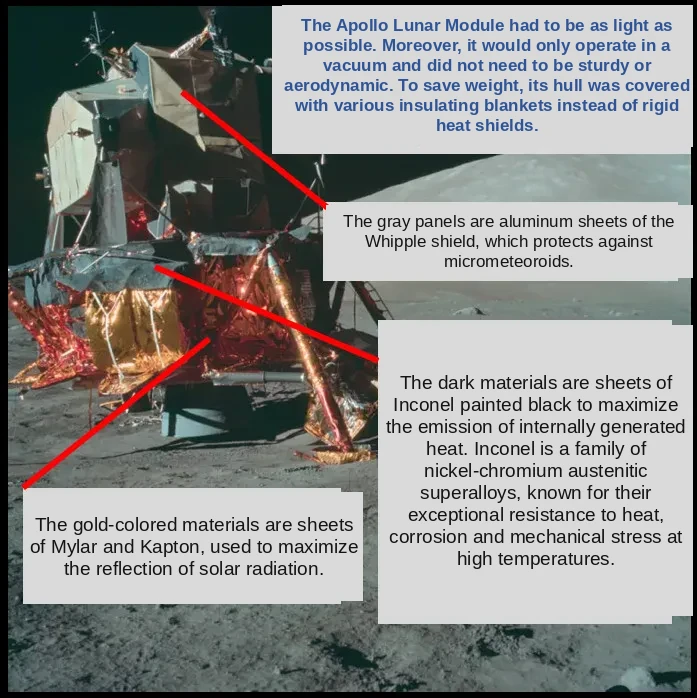
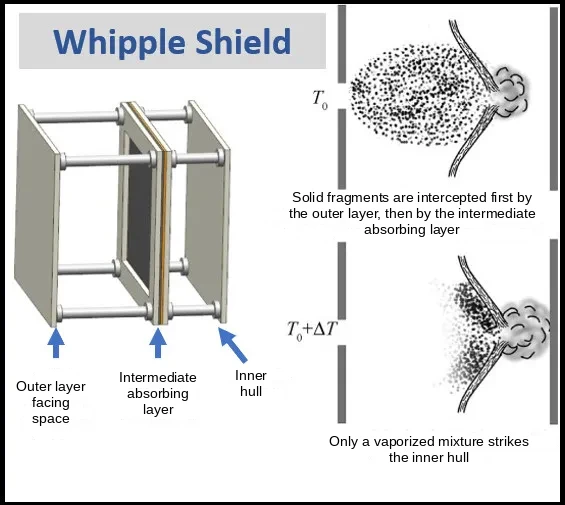 Another danger often cited by conspiracy theorists to dispute the authenticity of the Apollo lunar missions is that of micrometeorites! In space, in fact, tiny fragments of rock travel at hypersonic speeds between 20 km/s (72,000 km/h) and 70 km/s (252,000 km/h). With no atmosphere to burn them up, the Moon is constantly bombarded by them. However, the statistical probability of being hit by a grain large enough to puncture a spacesuit during the few hours of the mission spent outside walking on the lunar surface is extremely low. To protect the astronauts from this insidious phenomenon anyway, the A7L suit was made up of a full 21 layers of different materials. The outer layers were made of Teflon, Beta Cloth (fireproof silica glass fiber) and Kapton. Their job was to thermally insulate the astronaut from the outside world, also protecting him from the insidious vacuum of space. Last but not least, the layering of the suit was designed to break up any micrometeorites on impact, creating what in aerospace engineering is called a Whipple shield. The structure of the upper part of the suit behaved like a real bulletproof vest, designed to dissipate the kinetic energy of these natural stray projectiles. On impact, the micrometeorite was instantly disintegrated and vaporized into plasma, reduced to a cloud of microscopic fragments. This lethal spray then inevitably ended its run , damped against the very fine mesh layers underneath, made of Dacron, Mylar and Nylon. The same principle had also been adopted to protect the LM: the "crinkled, gold-colored outer skin" that gave it that deceptively fragile appearance or, as conspiracy theorists say, the look of a "shack made of tinfoil and duct tape", was actually a lightweight multilayer shield, called MLI and made mainly of Kapton, Dacron, Mylar and aluminum foil. Besides thermally insulating the sturdy aircraft-grade aluminum structure underneath, the MLI blanket also acted as a bulletproof vest, protecting the intrepid lunar spacecraft, its tanks, its equipment, its batteries and the pressurized structure underneath containing the crew cabin from possible micrometeorite impacts, thus making possible and safe the astronauts' stay on the lunar surface for the short exploration periods. One last important point must be made! The LM was the pioneering machine par excellence that laid the foundations of today's aerospace science. It is no coincidence, in fact, that most satellites and robotic probes exploring the planets of the solar system are entirely covered with the same crinkled, gold-colored blanket used in the Apollo program. The MLI blanket, in fact, is an excellent defensive shield still used today to venture into deep space, successfully meeting the danger posed by temperature swings and stray micrometeorites. For more information, see the chapter debunking the conspiracy ravings about the physical makeup of the LM by clicking here.
THE PROBLEM OF IONIZING RADIATION IN SPACE AND ON THE MOON:
 Detail of the layout of the Van Allen belts. In red, the inner toroidal belt, made mainly of high-energy protons, largely produced by the interaction of cosmic rays with the atmosphere. In gray, the outer toroidal belt, made mainly of electrons.Finally, let's talk about the conspiracy theorists' last warhorse for disparaging the authenticity of the Apollo lunar missions: the hostile presence of ionizing radiation in space and on the lunar surface, which would inevitably have killed any reckless astronauts who dared set foot there! To tackle this point scientifically, it is essential first of all to clarify the distinction between exposure dose and exposure time. In health physics and radiation protection, biological damage is not determined only by the intensity of the radiation, but by the product of this intensity and the duration of the exposure itself. The dose indicates the amount of energy deposited in the tissues, while time represents the window during which this absorption takes place. Being exposed to radiation of medium intensity for a very short time (as happens during an X-ray exam) is infinitely less dangerous than being exposed to weak but constant radiation for years. The Apollo missions were conceived precisely as "quick raids": the survival of the crews was not left to chance, but to rigorous management of the time factor, making sure that the total accumulated dose never exceeded the critical thresholds of biological safety. It should be made clear, as a detailed premise, that on the lunar surface the astronauts were always exposed to three types of radiation threats: Galactic Cosmic Rays (GCR), that is, high-energy particles coming from outside the solar system; Solar Energetic Particles (SEP), made up mainly of protons, electrons and helium nuclei emitted by the Sun; and secondary radiation (neutrons and gamma rays) produced by the interaction of cosmic rays with the lunar regolith (the so-called "neutron albedo"). To counter these dangers, NASA adopted a radiation protection strategy based on shielding and on optimizing the overall exposure times. The A7L spacesuits offered excellent protection against SEP particles, while the solid aircraft-grade aluminum hull chosen for the CSM (Command and Service Module) and the LM (the Lunar Module , which could also count on the additional protection of the MLI blanket) provided a significant barrier to absorb and cut down much of the other incident radiation. This made it possible to keep the values within tolerable limits, provided that the exposure times planned for each lunar mission were strictly respected . The historical data (available at this link) confirm the effectiveness of these measures: the Apollo 11 astronauts, for example, received a total dose of about 0.18 rad, values comparable to a series of chest X-rays or to a few mammograms. The most exposed of the whole program were the Apollo 14 astronauts: because of a particular planned trajectory, needed to
 Detail of the trajectories to and from the Moon (blue line), carefully worked out by NASA to cross the Van Allen belts through their thinnest and least dangerous part. Courtesy NASA.reach the lunar orbital plane of the Fra Mauro landing site, the spacecraft passed through a more internal and intense zone of the Van Allen belts, bringing the exposure to about 1.14 rad. Even in this case, however, the dose remained limited: the amount absorbed by the crew is roughly equivalent to one abdominal CT scan or 3-4 years of exposure to the natural background radiation we are all subject to living on Earth, on average at sea level. In short, over the entire mission the astronauts absorbed less radiation than a cancer patient receives during a single radiotherapy session. It should also be said that exposures only became substantial while crossing the Van Allen belts, whose effects were reduced thanks to the high speeds involved (about 39,000 km/h or 10 km/s during the crossing), which limited the transit to 1 or 2 hours at most. Even during the cruise between the two worlds, despite the loss of the partial shielding offered by the huge masses of the Earth and the Moon, exposure was not a critical problem. All the missions, in fact, took place in periods of relative solar calm, reducing the chance of meeting unpredictable energetic events to mere statistical odds, on the whole negligible. But what would have happened if a violent solar eruption had suddenly occurred? An intense SEP event could have hit the astronauts with
 Solar eruption with a coronal mass ejection. Photo courtesy NASA. potentially lethal doses if they had been outside at that moment. To prevent this risk, NASA had the Solar Particle Alert Network (SPAN), a worldwide network of optical and radio solar observatories (located in Texas, Australia, the Canary Islands and other sites) that monitored the Sun 24 hours a day. In the event of a major flare or coronal mass ejection , NASA would have had several hours of warning before the most energetic particles arrived in Earth orbit, allowing the astronauts to get back into the LM or the Command Module, whose metal walls would have reduced the dose to tolerable levels. Returning within the protective umbrella of Earth's magnetosphere before the arrival of the onrushing solar particles , however, was always NASA's main option . If the Sun had acted up, therefore, the safety protocols required the immediate termination of the mission and a rapid return of the astronauts to Earth. The interaction of the crews with the radiation in deep space or on the lunar surface was observed and reported several times by the astronauts, and the phenomenon of light flashes (phosphenes) was a classic example. As space exploration began, more and more crews reported to Mission Control that they had seen strange flashes of light or sudden glows, visible above all when the spacecraft lights were dimmed for sleep. This phenomenon was carefully investigated by NASA with specific experiments, initially thought to result from the negative effects of microgravity or from some other phenomenon of unknown origin acting on the eyes or the central nervous system. It was established later, thanks to analysis of the data from the experiments, that these sudden optical flashes were caused by the energetic interaction of cosmic rays (HZE charged particles) with the human eye: crossing the fluid of the eye at relativistic speeds, these particles could in fact generate Cherenkov radiation capable of exciting the photoreceptor cells of the retina. The low frequency of the events, however, was due to the fact that these interactions only became possible when the bulkheads were crossed by very energetic rays which, by mere chance, had not interacted with the shielding metal of the hulls. This very factor shows that, if NASA had wanted to fake the missions in a film studio on Earth, it could never have predicted or described so accurately a biophysical phenomenon tied exclusively to the deep space environment, confirmed decades later by specific studies on the ISS, carried out also by space agencies independent of NASA such as ESA and JAXA. The reality is that space is a hostile environment, but the 'hard facts' tell us that the radiation levels encountered, although higher than on Earth, were never even remotely close to the lethal doses claimed by conspiracy theorists.
IN CONCLUSION ...
In short, an objective analysis of the technical data shows that the objections raised by conspiracy theorists about temperatures, radiation and micrometeorites completely lack scientific rigor and rest on a mistaken perception of the environmental conditions in space and on the lunar surface. The deniers' methodological error lies in wanting to apply at all costs Earth's dynamics to an environment with no atmosphere. Claiming that lunar heat was an insurmountable obstacle means ignoring NASA's careful planning, which strategically placed the missions at lunar dawn so as to operate in a controlled thermal regime. Likewise, calling the radiation encountered during the Apollo program "lethal" is a claim refuted by the dosimeters and by the objective analytical data reported with great completeness and scientific rigor: the values recorded, comparable to common hospital diagnostic procedures such as CT scans, are well within the safety limits for the human body. Finally, the micrometeorite threat, although real, was neutralized through proven engineering solutions, such as the Whipple shield and multilayer materials, whose effectiveness is documented and still today underpins the protection of satellites, interplanetary probes and space stations. The radiation protection standards developed in those heroic years have also helped keep crews safe, allowing them to stay in space for long periods without falling ill. Declaring the Apollo missions a fake on the basis of these alleged thermal or radiation anomalies is therefore not an act of critical skepticism, but a rejection of the laws of thermodynamics, ballistics and biophysics. Every parameter of the mission, from the choice of launch window to the chemical composition of the Kapton coverings, follows a logic of crew protection based on calculations that are certain and verifiable anywhere , and on the websites of NASA and ESA (indeed, of all the world's space agencies) there is a large body of certified documentation available at any time. In conclusion, the challenges posed by the lunar environment were not denied, but faced and solved through top-level scientific planning, once again making the conspiracy claims completely untenable in the face of a serious review of the mission data. We are still waiting for conspiracy theorists to produce equally complete data refuting what has been stated not only by NASA but by every serious scientific body in the world. We are sure we will have to wait a long, long time for them ...