The alien artifact of Apollo 17 ...
Another stronghold of conspiracy delusion concerns a video shot by the rover's camera on the surface of the Moon during the Apollo 17 mission in December 1972. The stage for that footage is one of the most spectacular and geologically ambitious places ever explored by human beings beyond Earth: the Taurus-Littrow valley. Set along the southeastern edge of Mare Serenitatis, this immense tectonic trough opens like a titanic, silent canyon, overlooked by stone giants such as the North Massif and the South Massif, mountain walls rising more than two thousand meters above the valley floor, more imposing than the Grand Canyon itself. In that theater of desolate magnificence, lit by the raw, cutting glare of a Sun that knows no atmosphere, Eugene Cernan and Harrison Schmitt — the first scientist-geologist to set foot on another world — were no mere visitors. They were hunting for the most remote secrets of lunar history: extremely ancient rocks dating back to the dawn of the Solar System, more than four billion years ago, and traces of relatively recent volcanism, such as the famous orange soil discovered at Shorty crater, essential for understanding how our satellite was born, evolved and eventually cooled down.
And it is precisely while the lunar module Challenger rests at the center of this cathedral of dust and basalt, and the electronic eye of the camera mounted on the front of the rover — the famous GCTA, short for Ground-Commanded Television Assembly, a sophisticated color television system built by RCA and remotely controlled by radio from operators on Earth — scans its surroundings, that at the thirty-five second mark today's viewer is struck by something seemingly inexplicable. Against the monochrome backdrop of the valley's gray slopes, a sharp, elongated orange shape appears, topped by a small light-colored bulge, which seems to float in midair above the lunar ground, completely unlike the natural shapes of the surrounding boulders. As if that were not enough, a few moments later one of the astronauts crosses the frame, stepping right between the lens and that mysterious object and blocking the view.
Courtesy of moonpans.com
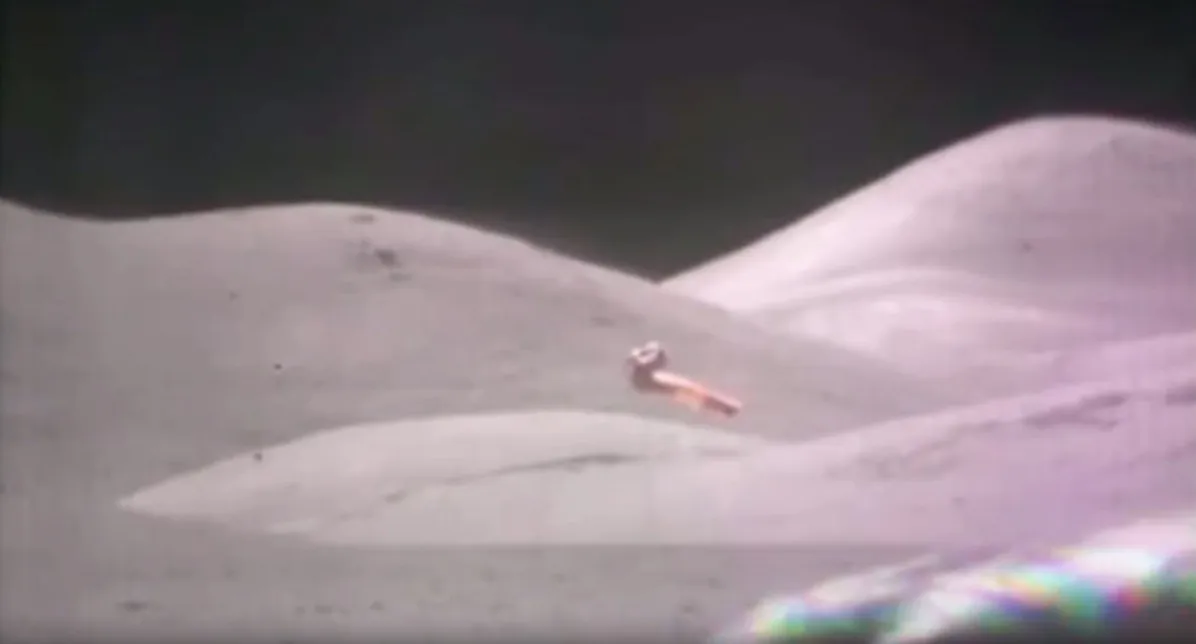
For the galaxy of Moon landing deniers and keyboard ufologists, those few grainy frames immediately become the Holy Grail, the smoking gun that would nail the American space agency to its own lies. The narrative that accompanies the compulsive sharing of this footage on social media is always the same, built with the alarmist tones of a mystery revealed. Supporters of alternative theories point at the screen and ask what NASA is really hiding from us. In their reading, that orange shape hovering over the slope would clearly be an extraterrestrial craft, an alien probe or a glowing ship hovering in place above the lunar ground to observe the activities of the Earthly intruders up close, or else a mysterious technological device linked to an underground base hidden in the folds of the valley. 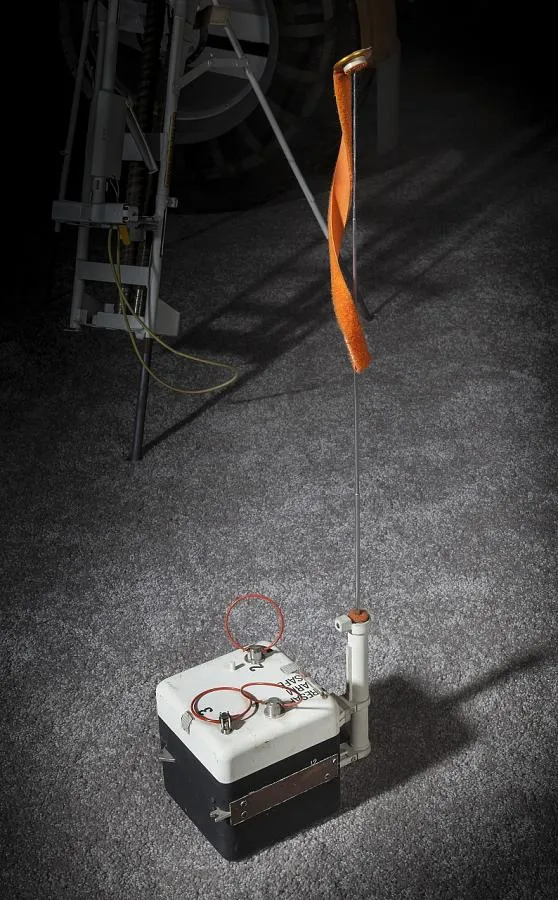 Courtesy of Smithsonian National Air and Space MuseumAnd the astronaut passing in front of the camera would be no accident at all, but rather a deliberate maneuver, a kind of physical censorship carried out live to stop the whole world from seeing any more of what was not meant to be seen.
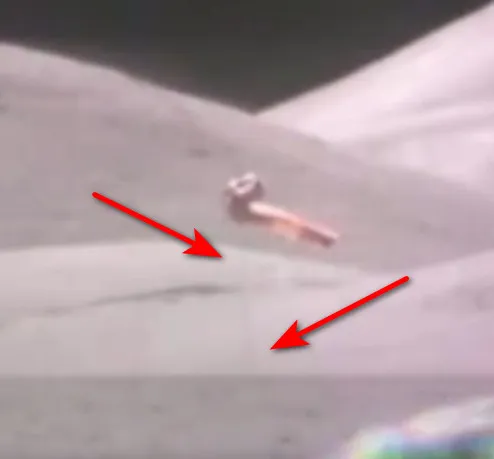
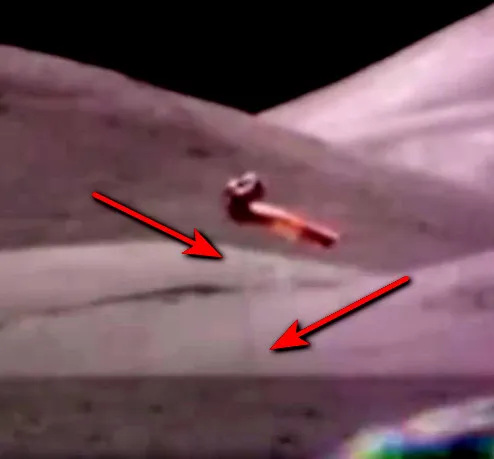
And yet, all it takes is to set aside science-fiction suggestions and look at those images through the eyes of science and historical documentation to watch the whole house of cards collapse. NASA never hid anything: that footage comes straight from the agency's public archives, and the mysterious object in it has nothing extraterrestrial about it, because it was designed and built by the Apollo program's engineers and carried to the Moon by the Apollo 17 astronauts themselves, Eugene Cernan and Harrison Schmitt. It is in fact the orange marker flag attached to the tip of the telescopic whip antenna of one of the eight explosive charges of the Lunar Seismic Profiling Experiment, one of the most ingenious scientific instruments of the Apollo 17 mission. The reason why the orange flag and the small round cap at its end seem to float in midair in front of the mountains lies entirely in the optical limits of the GCTA camera and in the extreme lighting conditions on the Moon. The very thin antenna rod, made of chrome-plated metal, reflects sunlight so strongly that it almost completely blends into the bright gray of the regolith and the slopes in the background of the low-resolution footage, so that at first glance only the high-visibility orange flag hanging sideways from its top stands out. It is a simple trick of perspective, an optical illusion that turns a small marker a few meters from the rover into an alleged spaceship flying over the mountains on the horizon, although, by watching the footage carefully, you can even make out against the light the thin, blurred outline of the metal rod holding up the flag.
At this point, the classic objection of those who refuse to surrender to the evidence shifts to the nature of the instrument itself. Why on earth would astronauts, officially engaged in a peaceful exploration mission, scatter explosive charges across the lunar surface? The idea seems so odd to non-specialists that it looks like a cover story invented after the fact to explain away the sighting. In reality, that technique is one of the pillars of modern geophysics and is called active seismology. To understand the interior of a celestial body without being able to drill kilometers into its crust, geologists need to generate artificial seismic waves and measure how long these vibrations take to travel and reflect through the rock layers underground. During their excursions in the Taurus-Littrow valley, Cernan and Schmitt placed eight explosive packages containing calibrated amounts of hexanitrostilbene (HNS), from about 57 grams up to almost three kilograms, spreading them at various distances around the lunar module, up to almost three kilometers away. To guarantee the crew's complete safety, each charge was fitted with safety timers that armed it only many hours after deployment, and it was detonated by a radio signal sent from the central station only after the astronauts had already lifted off aboard Challenger's ascent stage and were safe in lunar orbit. And there is more: the rover's camera, left behind on the Moon and still commanded from Houston, filmed the explosion of the second charge live, and Mission Control's screens showed the flash and the cloud of dust thrown up by the detonation, hundreds of thousands of kilometers away. The controlled explosions produced small artificial quakes that were recorded by the four geophones installed on site, allowing scientists to reconstruct with extraordinary precision the geological structure of the lunar crust down to a depth of a few kilometers. Even the impact of Challenger's ascent stage, deliberately crashed onto the Moon after the astronauts had returned to the command module, was used as a seismic source and was recorded not only by the Apollo 17 geophones but also by the seismometers left by Apollo 12, 14, 15 and 16.
Courtesy of Smithsonian National Air and Space Museum
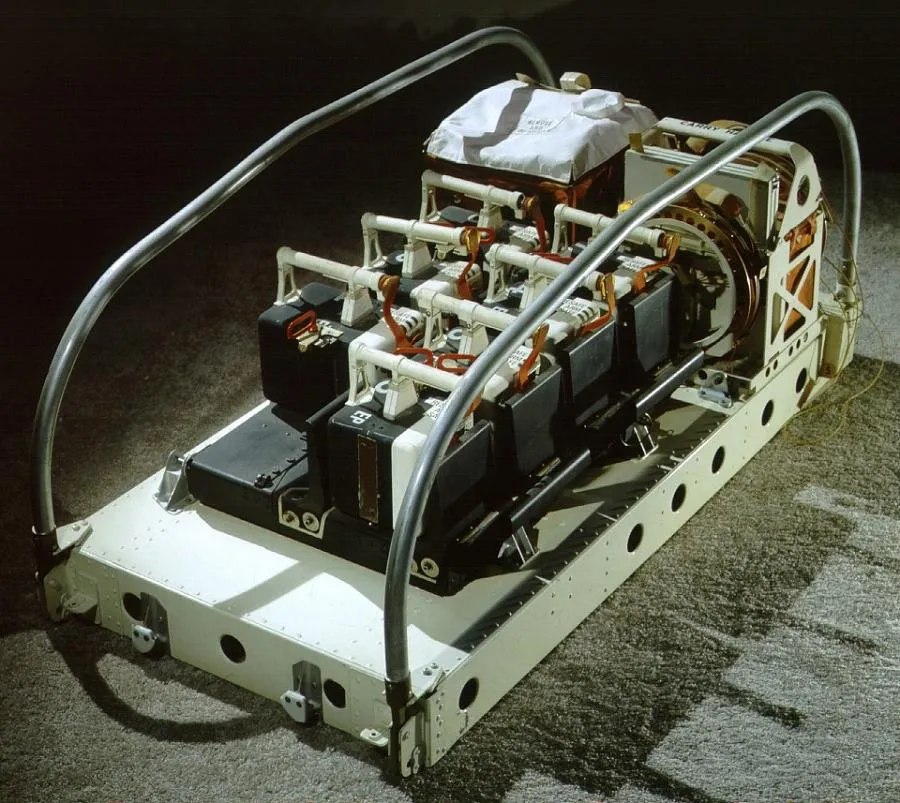
Even the presence of an orange ribbon in a world without air or wind, which conspiracy theorists see as an absurd or suspicious detail, actually met a precise operational need. Driving the lunar rover over rough terrain, dotted with craters and boulders, with the Sun low on the horizon casting very long and blinding shadows, made it extremely easy to lose sight of the small black-and-white explosive packages lying on the regolith. The engineers at Bendix, the company that built the Apollo surface experiments, therefore fitted each package with a vertical rod serving two purposes: on the one hand it acted as a receiving antenna to pick up the radio detonation signal, and on the other it held up that very conspicuous orange flag, which made the charges recognizable at a glance as the astronauts moved around the work area. An identical unit, with the same orange flag attached to the top of the antenna and the synthetic disk at its tip, used for training and never flown in space, is kept in the collections of the Smithsonian National Air and Space Museum in Washington: its online record, with photographs, lets anyone compare it with the frame from the video.
That leaves the last pillar of the conspiracy theory: the astronaut walking in front of the lens right after the object appears, interpreted as a clumsy but deliberate attempt to hide the evidence. Here too, the operational reality of the mission dismantles every hidden-agenda theory. Precisely because the GCTA was a system remotely commanded from Mission Control in Houston — where a dedicated operator, Ed Fendell, could pan it, tilt it and work the zoom from afar with a delay of just a couple of seconds — the images were transmitted straight to Earth in real time. The astronaut on the surface had no monitor on which to check exactly what the lens was framing at that moment, nor would he have had any reason to try to cover with his body an image that NASA itself was already receiving and recording almost four hundred thousand kilometers away, or that the operator in Houston could simply have framed again by turning the camera a moment later. Around the parked rover there was a constant coming and going to unload tools, collect rock samples and calibrate scientific instruments; walking in front of the camera mounted on the front of the rover was a trivial, frequent and completely unavoidable event.
What emerges from a rigorous analysis of this footage, then, is a valuable lesson in how space hoaxes work. Conspiracy thinking almost always feeds on decontextualization: it isolates a single grainy detail, strips it of the technical documentation that goes with it and projects its own fantasies onto the shadows of another world. But the real story of lunar exploration does not need alien spaceships to be fascinating. It is infinitely more extraordinary to think that more than half a century ago two human beings crossed the void of space to drive an electric vehicle through a lunar valley, scattering sensors and explosive charges to listen to the deep echo of another world and uncover its geological secrets.
Anyone who wants to relive those extraordinary days up close can still do so today: the entire mission can be followed minute by minute on Apollo 17 in Real Time, with the original audio, television images and photographs all synchronized, while NASA's Apollo Lunar Surface Journal collects the full transcripts of the moonwalks, annotated by the astronauts themselves. A journey through the Taurus-Littrow valley that no grainy video could ever match.